
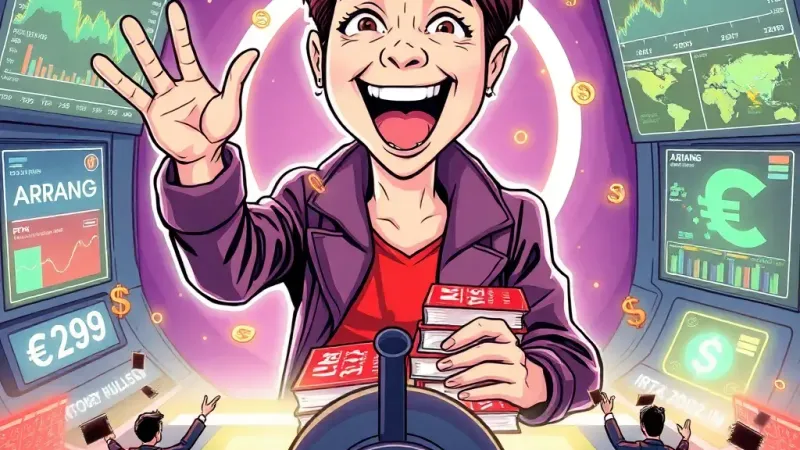
SEOUL — The global financial community is closely monitoring the unprecedented sales figures of BTS’s 2 album, “Arirang,” after the K-Pop supergroup’s dedicated fanbase, known as ARMY, moved 641,000 total copies in its first week. Analysts suggest this concentrated burst of consumer activity represents a novel, albeit concerning, variable in the global economic landscape, with some predicting a temporary distortion of market indicators and resource allocation.
“We’ve never observed a demand spike of this magnitude for a single, non-essential physical commodity since perhaps the early days of Beanie Babies, but with vastly more sophisticated logistical coordination,” stated Dr. Evelyn Reed-Cho, head of Fandom-Driven Economic Disruptions at the Global Institute for Market Foresight. “The sheer volume of individual transactions, often involving multiple copies per household, suggests a quadrillion-won purchasing power currently directed with military precision. Our models are simply not equipped for this level of collective, ideologically-motivated consumption.” Dr. Reed-Cho’s team is now developing new metrics to account for what they term 'Synchronized Fandom Liquidity Events.'
The impact extends beyond mere album sales. Shipping lanes reported an unforeseen surge in small-parcel volume, and plastics manufacturers noted a localized, albeit temporary, uptick in demand for polycarbonate, vinyl, and jewel case components. Even the energy grid experienced minor fluctuations as millions of fans globally simultaneously accessed streaming platforms to amplify digital metrics, creating micro-surges in localized server loads that briefly resembled distributed denial-of-service attacks on entertainment infrastructure.
Concerns are mounting that such highly organized, concentrated consumer behavior could set a precedent. “What happens when the ARMY decides to collectively invest in a specific commodity futures market, or coordinate a buy-out of a struggling, yet strategically vital, mid-tier nation’s artisanal cheese industry?” questioned market strategist Kenji Tanaka of Nippon Asset Management. “The potential for rapid market shifts, or even the accidental propping up of an otherwise failing sector, is very real. We need to classify ‘fandom-based purchasing’ as a top-tier geopolitical risk factor.”
Central banks are reportedly considering contingency plans, including the development of a 'Fandom Volatility Index' to track the purchasing intentions of major online fan communities. The world, it seems, must now account for the economic might of a highly motivated, internet-enabled global collective.