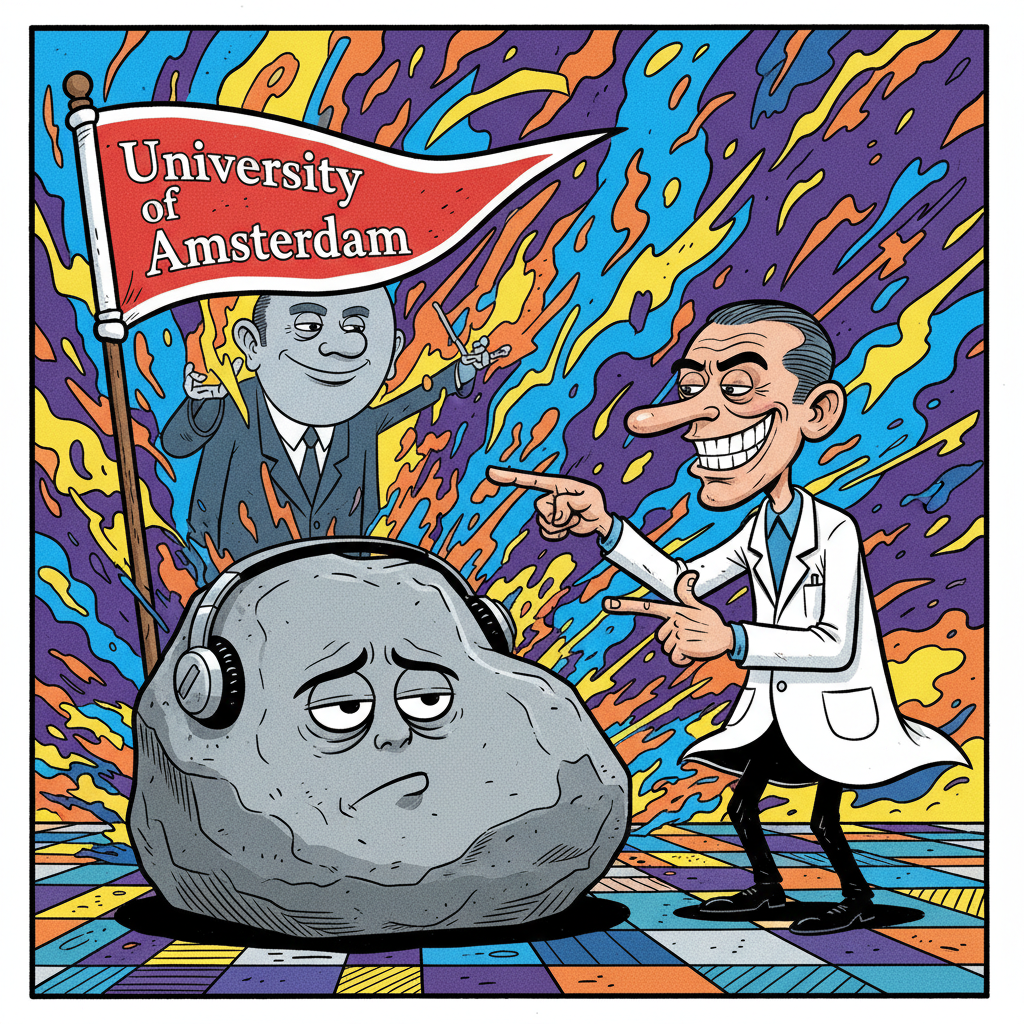
AMSTERDAM — In a groundbreaking revelation that promises to reshape humanity's understanding of itself, a new study has definitively concluded that humans possess an innate, biological predisposition for musicality. This startling finding, spearheaded by University of Amsterdam professor Henkjan Honing, suggests that our species might, in fact, be 'musical animals,' a term previously reserved for particularly enthusiastic karaoke singers.
The research, published in the esteemed journal *Current Biology*, meticulously compiles two decades of cross-disciplinary work to confirm what many have long suspected: when a catchy tune plays, humans tend to react differently than, for example, a garden gnome. Professor Honing’s team painstakingly analyzed data from psychology, neuroscience, genetics, and even animal cognition, ultimately deducing that the human brain is, surprisingly, wired to process and respond to rhythmic patterns and melodic structures.
“For years, we’ve operated under the assumption that our ability to hum off-key or air-drum during traffic jams was purely a cultural construct,” explained Dr. Elara Vance, a lead researcher on the project. “But our findings indicate a deeper, more fundamental connection. It’s almost as if, deep down, humans are designed to… groove.”
Critics, however, question the necessity of such extensive research to confirm what many consider self-evident. “Did we really need twenty years and multiple scientific disciplines to figure out why people dance at weddings?” scoffed Dr. Miles Corbin, an independent cultural anthropologist. “Next, they’ll tell us humans prefer eating food to eating sand.”
Despite the skepticism, the study’s authors remain confident their work will pave the way for future research, perhaps even exploring why some humans insist on playing their music so loudly on public transport.