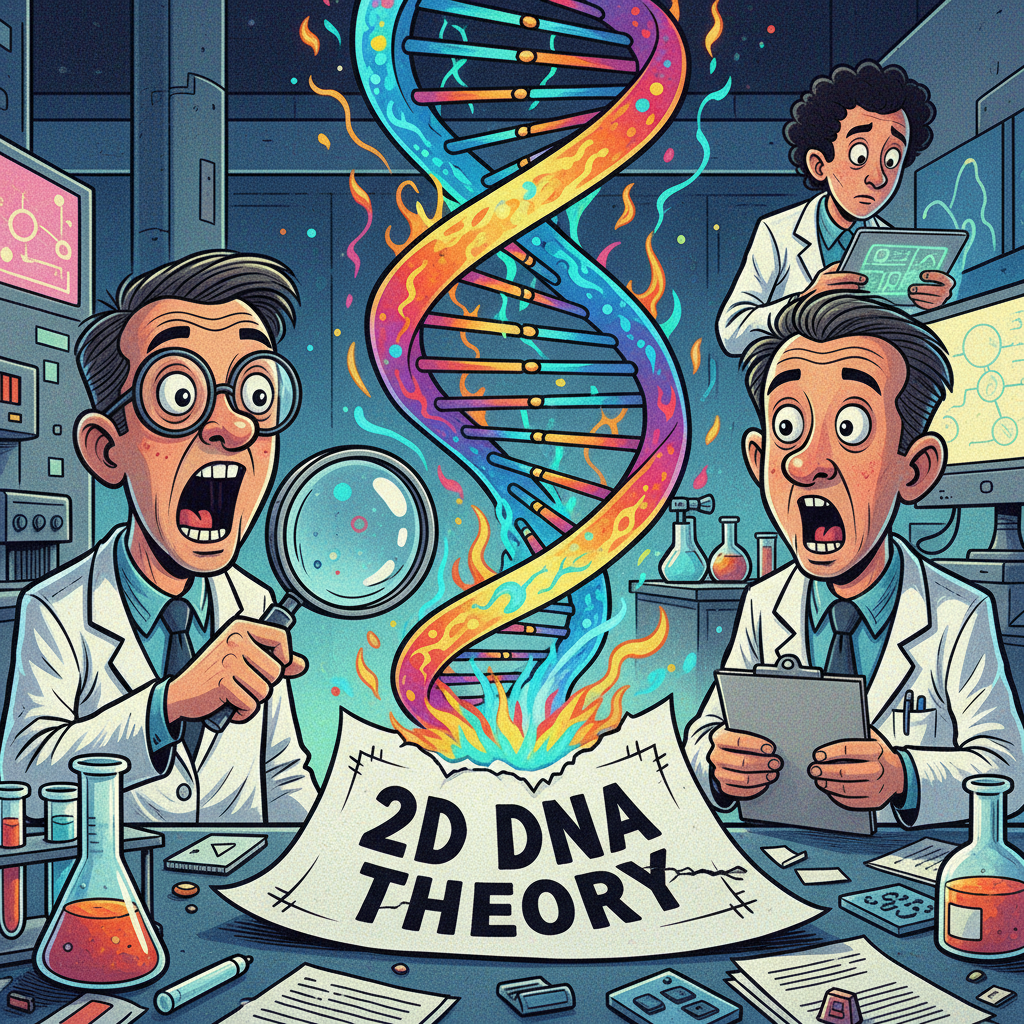
MEMPHIS, TN — In a stunning revelation that has sent shockwaves through the scientific community, researchers at St. Jude Children's Research Hospital have confirmed that DNA, the fundamental building block of life, operates in a three-dimensional environment. This discovery challenges the long-held, albeit unstated, assumption that genetic material primarily functions as a series of flat, linear instructions, much like a badly folded map.
The team, led by Dr. Evelyn 'Evie' Chen, unveiled an algorithm dubbed 'BOUQUET' that can map '3D-super-enhancers,' which are apparently things that exist in 3D. "For years, we've been trying to understand how cells work by looking at them like they're drawn on a napkin," explained Dr. Chen, visibly exasperated. "Turns out, they're more like a really complicated, tiny, squishy sculpture."
Critics are questioning why it took so long for the scientific establishment to grasp this basic spatial concept. "It's like discovering water is wet, but for Nobel laureates," quipped Dr. Miles Corbin, a theoretical biologist from the University of Arizona, who admitted he always just 'figured' DNA was 3D but never bothered to check. "We were too busy trying to find the gene for 'being good at parallel parking' in a flat spreadsheet."
The implications are vast, with some experts suggesting this new understanding could lead to breakthroughs in medicine, or at the very least, a new line of more spatially accurate DNA models for high school biology classes. The research is expected to pave the way for future studies into whether cells also possess a sense of humor or a preference for artisanal coffee.