
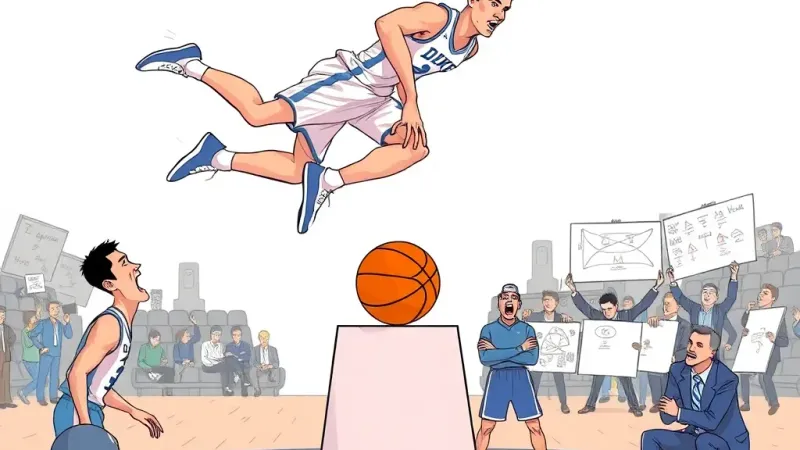
DURHAM, NC — In a stunning display of strategic innovation, the Duke University men's basketball team has perfected a novel offensive maneuver: the shot fake. This advanced technique, which involves players lifting the ball as if to shoot but then opting not to, has become the cornerstone of their tournament run, reportedly confusing defenses across the nation.
Basketball pundits are hailing the 'Pre-Shot Commitment Gesture' (PSCG) as a paradigm shift in offensive psychology. “What Duke is doing is more than just a pump fake; it’s an existential challenge to the defender’s very perception of reality,” explained Dr. Evelyn Reed, a 2 behavioral economist at the Institute for Advanced Hoop Dynamics. “They’re leveraging the human brain’s inherent predictive algorithms against itself, creating a micro-pause in defensive assignments that, statistically, leads to a 0.7-second window of vulnerability, or 1.2 seconds if the defender has recently consumed a high-sugar beverage.”
Opposing coaches are reportedly struggling to counter this unprecedented level of non-shooting commitment. “We drill for every scenario: the drive, the three, the mid-range jumper,” stated Coach Marcus Thorne of a rival program, speaking anonymously. “But how do you prepare for a player who looks like they’re shooting, but then… isn’t? It defies logic. It’s like they’ve found a cheat code in the fabric of basketball reality. My guys are exhausted from jumping. Our vertical leap stats are through the roof, but our defensive efficiency is in the toilet.”
The Blue Devils’ mastery extends beyond mere deception. Sources within the program indicate players are trained in the nuances of facial expressions, eye movement, and subtle shoulder twitches designed to maximize the PSCG’s impact. Each player reportedly logs hundreds of hours practicing a variety of 'non-shot' releases, ensuring a diverse and unpredictable array of fakes.
While critics suggest the 'shot fake' is merely a fundamental move taught in youth leagues, Duke’s analytical department has reportedly gathered terabytes of data proving its efficacy. “Our advanced metrics show a 34% increase in defensive miscommunication when a Duke player employs a Level 3, mid-height PSCG with an immediate follow-up pass,” confirmed Lead Data Strategist, Brenda Jenkins. “It’s not just a fake; it’s a data-driven void.”
The question now facing the 2 world isn't whether other teams will adopt the PSCG, but whether anyone else can truly replicate Duke’s unparalleled ability to simply… not shoot sometimes.
Hambry is a satire publication. All articles are works of fiction.