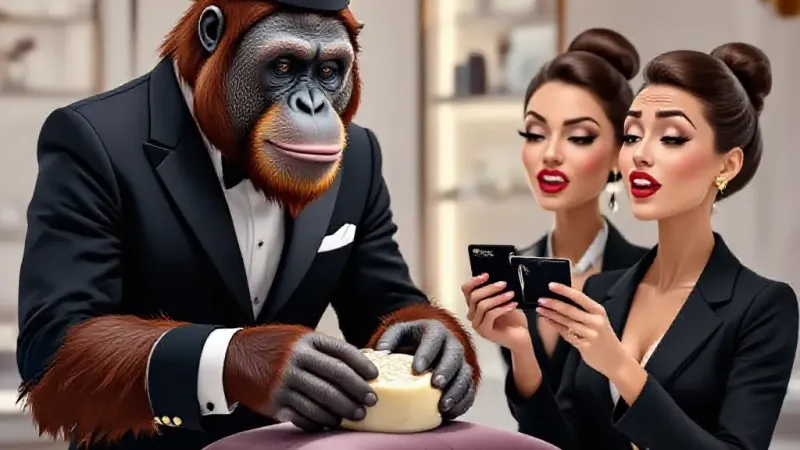
NEW YORK — In a groundbreaking move hailed by analysts as "pure genius," major corporations are rolling out premium product lines explicitly labeled "human-made," capitalizing on a burgeoning market for items allegedly untouched by artificial intelligence. From artisan-crafted spreadsheets to bespoke customer service emails, companies are discovering that merely *not* using a sophisticated algorithm can fetch prices previously reserved for limited editions or actual quality.
"It’s the evolution of scarcity economics," explained Dr. Brandish Tacticool, head of the Institute for Organic Sentiment Exploitation. "We learned with 'all-natural' that consumers love paying more for the absence of something they vaguely fear, even if that something wasn’t likely there in the first place, or if its alternative is negligible. Now, with 'no AI,' we’re selling the glorious, inefficient touch of human error and charging a 30% authenticity premium. Our projections show the 'human-made' market segment growing faster than influencer-endorsed diet teas, primarily because the production costs are often identical to the 'AI-adjacent' version."
Industry insiders note this strategy is particularly effective for products where AI integration was either non-existent, universally terrible, or utterly unnecessary. "Why just sell a shirt when you can sell a '100% human-designed, human-stitched, human-packaged' shirt?" posed a spokesperson for lifestyle brand "AuthentiCorp," which recently unveiled its "No AI" activewear line, despite AI never having been involved in their textile production. "It implies a level of care and artisan effort, even if the human designer just copied a Pinterest board while watching Netflix for an hour and then outsourced the actual pattern-making to a generative tool they just don't *call* AI."
Analysts predict a rapid expansion of the "human-verified" label across every sector. Soon, your morning coffee might boast "human-grown, human-roasted, human-poured" for an additional dollar, implying a sentient robot barista didn't spit in it. Your data plan could offer "human-routed packets" for a premium, reassuring you that no neural net is judging your late-night streaming habits. Even major tech firms, the very pioneers of AI, are rumored to be launching "No AI" versions of their software, promising that critical bugs and security vulnerabilities were introduced exclusively by tired, underpaid engineers, not by a machine learning model.
The trend culminates in the ultimate luxury: a brand promising that even its stock photography models were "never AI-generated." Consumers, ever vigilant for a new way to prove their discernment, seem poised to fork over unlimited sums to avoid anything that hints at a synthetic touch, ensuring that the only thing artificial about their purchase is the perceived value. This creates a fascinating parallel where brands simultaneously push for maximum AI integration internally for efficiency, while aggressively marketing its complete absence externally for profit.
Expect the next phase to be 'organic content,' where influencers manually type out posts without relying on an AI to craft their engagement-optimized platitudes, then charge double for the 'authenticity'.