
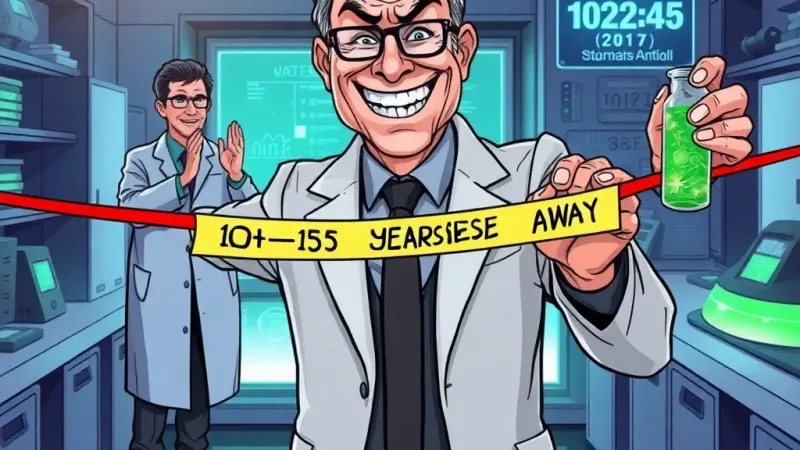
ST. LOUIS, MO — Scientists at the Donald Danforth Plant 2 Center have announced a groundbreaking discovery in the field of microalgae metabolism, a finding so significant it is expected to ensure that the widespread commercial viability of algae-based renewable fuels will remain a comfortable 10 to 15 years in the future. The research, published in the prestigious *Proceedings of the National Academy of Sciences*, details how certain green microalgae strategically reorganize their central metabolism to "supercharge" growth when given access to both light and a carbon source—a process now understood to be critical for keeping the energy sector in a state of perpetually anticipated innovation.
"What we've really achieved here is a deeper understanding of how to keep the 'promise' of algae alive and well, perpetually hovering just beyond the commercial horizon," explained Dr. Felicity Rindt, lead researcher on the project. "It's a delicate balance. We need enough progress to justify continued funding and public excitement, but not so much that it actually becomes a readily scalable solution within, say, the next five years. That would upset the careful equilibrium of future projections, grant cycles, and investor presentations which depend on a healthy level of aspirational uncertainty." Dr. Rindt noted that the discovery unlocks previously unseen metabolic pathways, which are now being meticulously cataloged to inform future studies that will, in turn, identify even more complex challenges requiring further investigation over the next fiscal decades.
The center's latest findings illuminate how the model green microalga *Chlamydomonas reinhardtii* utilizes a sophisticated internal switching mechanism to optimize its resource allocation, a revelation energy analysts believe will be instrumental in drafting next-generation strategic roadmaps for 2035-2040. "This isn't just about unlocking algae's potential; it's about unlocking the potential for *more research* and the continued employment of thousands of dedicated scientists," stated Mr. Silas Vance, Director of Future Fuels Advocacy at the American Energy Futures Institute. "Every 'breakthrough' is a vital stepping stone, each one perfectly positioned to underscore the critical need for sustained investment in the nascent stages of innovation. Without these regular infusions of new, complex information, the 'future fuel' narrative could lose its necessary allure."
Further analysis of the algae's "supercharged growth" revealed that while the organisms do proliferate rapidly under controlled laboratory conditions, the exact parameters for replicating this efficiency at an industrial scale are "exquisitely specific" and "potentially incompatible with Earth's current atmospheric or aquatic conditions," according to a supplemental report. This ensures that the immediate application of the findings will primarily be in the creation of more sophisticated computer models and theoretical frameworks, rather than actual fuel production facilities. "We're not just kicking the can down the road; we're meticulously engineering a longer, more fascinating road for the can to travel," added Dr. Rindt, highlighting the nuances of long-term sustainable research.
Industry experts anticipate this breakthrough will lead to a fresh wave of venture capital interest in early-stage algae startups, all of which will project commercial readiness by 2040 at the earliest. The enthusiasm is palpable among researchers who foresee a vibrant era of grant applications focused on "optimizing the supercharged growth for scalable bioproduct integration under hypothetical large-scale environmental stressors," ensuring the consistent deferral of tangible market penetration. Investment analysts lauded the predictable nature of the 10-15 year timeline, calling it "a benchmark of stability in an otherwise volatile energy market."
This latest development solidifies algae's status as a perpetual "fuel of the future," consistently poised on the cusp of relevance, much like commercial fusion power, true artificial general intelligence, and the eventual implementation of universal basic income.