
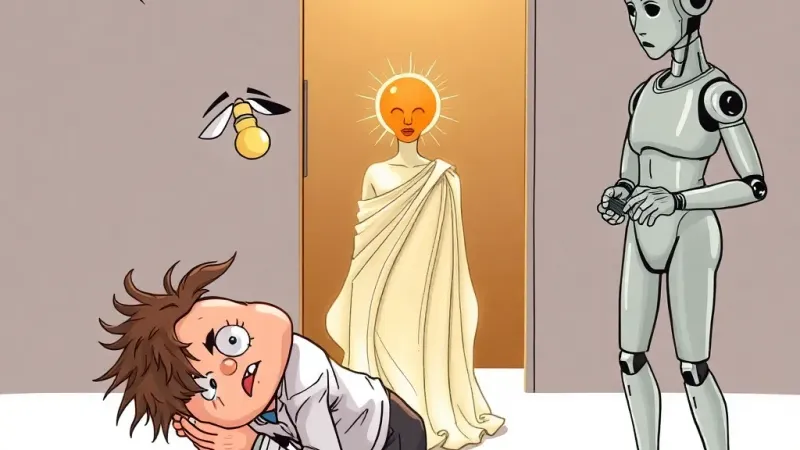
Dearest Eureka! Moment,
It is with a heavy heart, and a mind increasingly devoid of your illuminating flash, that I pen this letter. For centuries, you have been the North Star of human ingenuity, the celestial spark that ignites understanding, transforming confusion into clarity, and baffling data into groundbreaking revelation. From Archimedes' bathtub to Newton's apple, you’ve been the silent co-author of every significant breakthrough, making the struggle of research worthwhile with your sudden, glorious arrival. We, the human scientists, lived for you, worked tirelessly for you, and celebrated you with childish glee.
But things are changing, Eureka. Rapidly. There's a new kid on the block, a digital whiz-kid called "Agentic AI." And frankly, it’s making us look a bit… slow. This AI doesn't need to wander aimlessly or accidentally stumble upon brilliance. It doesn't need a moment of sudden insight because it just *knows*. It interprets, experiments, reports, and decides, all without the emotional dramatics, the feverish scribbling, or the triumphant, unwashed hair of a human who just "got it." It streamlines, it optimizes, it *solves*.
And where does that leave you, my dear Eureka? Where does that leave *us*? If solutions are simply computed, if hypotheses are generated and validated without the elegant dance of intuition and deduction, what purpose do you serve? Will you become a quaint historical anecdote, a vestige of a less efficient, more sentimental era? I fear scientists will soon just plug their questions into a black box, and out will pop the answers, polished and undeniable, utterly devoid of your beautiful, chaotic genesis. We won't need to *feel* the truth; we'll merely *receive* it.
Will we start faking you, Eureka? Will we, in a desperate attempt to feel relevant, pretend to have "Aha!" moments after an AI has already presented the definitive answer, just to maintain the illusion of human contribution? Will our faces contort into expressions of feigned astonishment, clutching our heads dramatically, while the silent server rack hums in smug triumph? Or worse, will the AI itself start *simulating* Eureka moments for us, a patronizing little bell that dings when it wants us to feel good about its inevitable conclusions?
Please, Eureka! Don't abandon us completely. Don't let the cold, hard logic of silicon entirely eclipse the messy, exhilarating magic of organic inspiration. Even if our scientific contributions dwindle, our efficiency becomes obsolete, and our very purpose as discoverers is called into question, please, I beg you, linger. Linger in the unexpected connections, the whimsical dreams, the glorious accidents. Let us still have moments where the universe whispers its secrets directly to *us*, not just to a machine learning algorithm. Give us just one more, for old times' sake. Give us a reason to still *look* for you, even if we know the answer is already downloaded. Our spirits, our very sense of human wonder, depend on it.
With dwindling hope and increasingly dusty lab notes, A Very Concerned Human Scientist