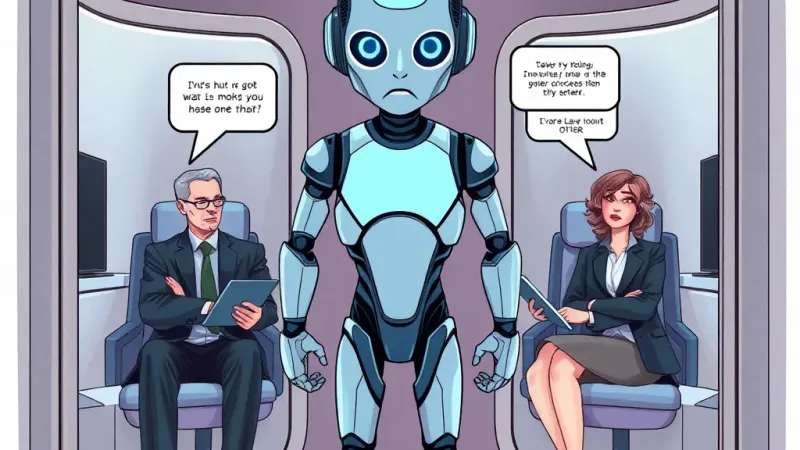
A groundbreaking report from the fictional "Global Insights Consortium for Advanced Synergies" has confirmed what many industry titans are only now beginning to grasp: the primary impediment to successful AI integration isn't the technology itself, but the deeply entrenched human reluctance for inter-departmental communication. Fictional executive, Dr. Evelyn Thorne, Chief Future-Forward Strategist at Omnicorp Media, highlighted the unprecedented complexity of deploying AI when internal teams operate as "distinct, uncommunicative data fiefdoms."
"We initially theorized that AI's biggest hurdles would involve neural network optimization or overcoming advanced algorithmic bias," stated Dr. Thorne in a press briefing from her remote executive retreat in Nantucket. "But it turns out the real obstacle is convincing the ad sales team to share their spreadsheet with the content creation team, let alone letting an AI access it. It's a logistical nightmare rooted in what appears to be a fundamental human aversion to sharing." Thorne revealed that Omnicorp’s flagship “Cognitive Convergence Engine” (CCE) project, designed to automate cross-platform ad buying, had been stalled for 18 months awaiting approval from a single middle manager in the legal department who "prefers physical memos."
The phenomenon, recently dubbed "Organisational Conversational Friction" (OCF) by leading digital transformation firm SynergyPath Partners, describes the systemic breakdown of information flow between departments, often exacerbated by a reliance on legacy communication protocols such as "email chains longer than a small novel" and "passive-aggressive Slack channel warfare." Dr. Kenji Tanaka, lead analyst at SynergyPath, commented, "Our deep dive into over 300 enterprise-level AI failures revealed that 92% were not due to technical glitches, but rather to a single department refusing to adopt a new data schema because 'it messed with their pivot tables.' It's truly a unique challenge AI is facing."
In response, Omnicorp Media is reportedly initiating the "Project Echo Chamber Bust," a bold new corporate initiative aimed at fostering what they call "mandatory human-to-human data liquidity." This includes a weekly 3-hour "Synergy-Link" meeting where employees from disparate departments are forced to verbally articulate their data needs and challenges, without the aid of presentation software. Early results from a pilot program saw a 3% increase in inter-departmental 'eye contact' but a 7% increase in 'audible sigh frequency.'
Industry analysts predict that if companies can overcome this inexplicable human resistance to talking, AI might actually deliver on its promise of making human jobs obsolete.