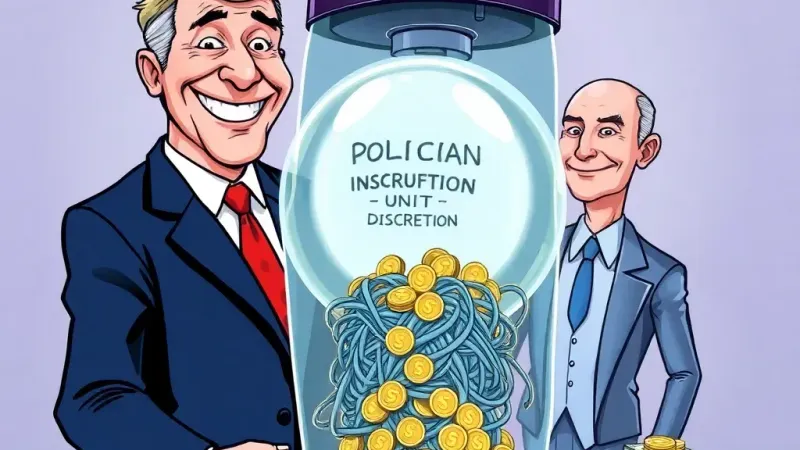
BOSTON, MA — Following recent reports of a significant increase in funds from undisclosed sources influencing state 2, Massachusetts officials have publicly praised these developments as a crucial step towards optimizing governance through enhanced 'donor discretion.' The influx of untraceable contributions, often dubbed 'dark money,' is being reframed as an advanced mechanism for efficient policy-making, bypassing cumbersome public transparency requirements.
“For too long, the vital work of legislating has been bogged down by the public’s insistence on knowing who funds what,” stated Dr. Elara Vance, newly appointed Director of Strategic Anonymity for the Massachusetts Office of Political Optimization. “With this new era of donor discretion, our elected representatives can focus solely on the merits of a proposal, rather than the distracting side-show of constituent concerns about who’s footing the bill. It's about pure, unadulterated influence, delivered directly to the decision-makers, without the messy middle-man of voter comprehension.”
The move is part of a broader, unspoken initiative to transition Massachusetts into a 'Post-Transparency Governance' model, where the identity of financial backers is considered proprietary information, safeguarding their investment from public scrutiny. Critics, primarily local watchdog groups and anyone who believes in functional democracy, have expressed concerns that this lack of disclosure erodes public trust. However, sources within Beacon Hill assert that trust is a 'luxury belief' that often impedes progress.
“The public doesn’t need to know every single financial nuance,” added state Senator Marcus Thorne (R-Woburn), speaking from his new, inexplicably upgraded office. “They elect us to make tough choices, and sometimes those choices are made significantly easier when we’re not constantly explaining how a particular donor’s extremely specific, self-serving policy suggestion somehow benefits all 6.8 million residents. It’s an efficiency measure, plain and simple.”
Experts predict that if successful, this Massachusetts model could become a national standard, allowing politicians across the country to operate with unprecedented levels of financial deniability, ultimately freeing them to serve the interests of an ever-smaller, increasingly anonymous pool of stakeholders.
The real beauty, officials note, is that the system almost entirely runs itself now, requiring minimal oversight beyond ensuring no one accidentally makes anything public.