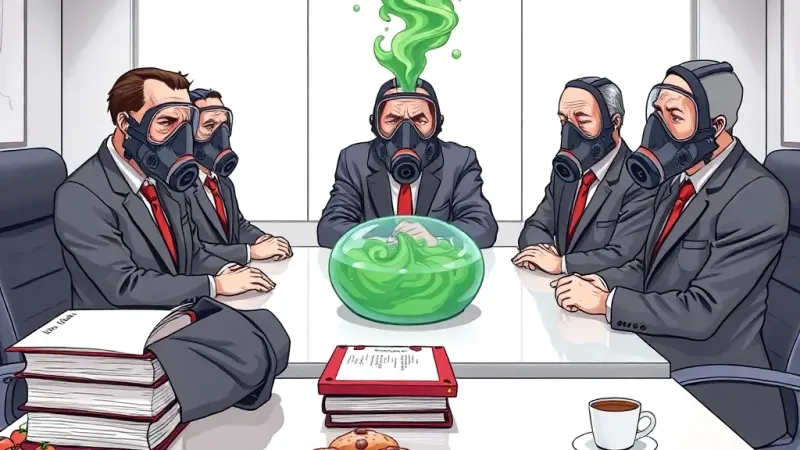
Following an urgent letter from the Association of Flight Attendants-CWA detailing persistent "fume events" and associated health impacts, major U.S. airlines announced today the formation of a joint task force to explore the fundamental properties of airborne substances that have been observed causing dizziness, nausea, and in some cases, long-term neurological damage in cabin crew and passengers. The "Air Quality Assessment and Rebranding Initiative" (AQARI) aims to definitively ascertain whether the noxious emissions, typically originating from engine oils, are, in fact, "toxic" in the colloquial sense, or merely "performance-enhancing ambient particulates" requiring further definition.
Brenda Whitewater, spokesperson for Airlines for America, emphasized the industry's commitment to "proactive stakeholder engagement." "We take all feedback seriously, especially when it arrives on official letterhead," Whitewater stated in a press conference held virtually from a pressurized, hermetically sealed bunker. "Our initial phase, 'Project Clarity,' will involve an exhaustive review of existing incident reports, cross-referenced with public domain weather patterns and anecdotal passenger anecdotes regarding spicy airplane meals. We want to ensure we're not conflating legitimate environmental concerns with, say, a particularly potent batch of in-flight peanuts."
The task force, comprised primarily of airline treasury department officials and marketing strategists, plans to commission a series of independent studies with a projected completion date of 2032. Dr. Eleanor Vance, a consultant specializing in corporate health and obfuscation at the Institute for Strategic Ambiguity, lauded the airlines' measured approach. "It's crucial not to jump to conclusions," Dr. Vance advised. "Before we can definitively label something as 'toxic,' we must first establish its precise negative impact on quarterly earnings. If the fumes are merely creating a minor inconvenience, such as a temporary loss of motor skills, that's a very different 'toxicity profile' than something requiring, for example, a mandatory recall of perfectly good aircraft."
Sources close to the newly formed committee indicated that early discussions have focused on potential terminology adjustments. Suggestions include renaming "fume event" to "atmospheric experience enhancement," and "toxic oil" to "eco-friendly performance lubricant with invigorating aromatics." A preliminary memo suggested that any future health complaints might be categorized under "voluntary participation in advanced sensory perception experimentation."
Ultimately, airlines affirmed their unwavering dedication to passenger and crew well-being, provided it doesn't interrupt the meticulous calibration of their shareholder value algorithms. The committee’s first recommendation is expected to be a new line of air fresheners marketed as "Cabin Calm™: The Scent of Profit."