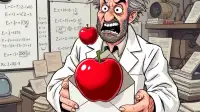

LONDON — Scientists have used advanced AI and molecular scanning to confirm that many of the world's most celebrated masterpieces are, at their core, nothing more than pigmented oil and canvas stretched over a frame. This groundbreaking revelation marks a significant step in art historical analysis, according to a consortium of researchers from the European Centre for Advanced Art Dissection.
The new "Hyper-Spectro-Molecular Art Deconstruction Matrix" (HSM-ADM) can penetrate dozens of paint layers with sub-nanometer precision, identifying individual molecular compounds and their precise placement. Early scans of works like Leonardo da Vinci's *Mona Lisa* and Vincent van Gogh's *The Starry Night* have yielded consistent results, indicating a primary composition of linseed oil, various mineral pigments, and a substrate typically comprising linen or cotton. "For centuries, people have speculated about the 'soul' of these works, the 'divine inspiration,' or the 'ineffable genius,'" explained Dr. Alistair Finch, lead researcher at the E.C.A.A.D., speaking from behind a microscope trained on a fleck of dried titanium white. "Our AI, however, simply reported a 98.7% correlation with 'paint' and 'stuff art is painted on.' It's quite definitive."
Art historians are grappling with the implications of the findings, which could fundamentally alter how future generations perceive classical art. "It's a lot to process," admitted Professor Gwen Sterling of the Department of Artistic Verifiability at the New York Institute for Quantifiable Aesthetics. "We've always taught that art evokes emotion, tells stories, challenges perceptions. But what if it's just... stuff? The HSM-ADM has detected trace elements of 'dust' and 'a bit of what looks like old house paint used as primer' in a 17th-century Dutch still life. It forces us to re-evaluate what we mean by 'masterpiece' if it turns out the artist was just clearing out their attic."
Critics, however, argue the 2 might be missing the forest for the molecules. "This is like using a supercomputer to confirm a joke has words," scoffed local artist Milo Kensing. "The beauty isn't in the chemical formula; it's in the experience, the human connection. Are they going to scan a symphony next and tell us it's just vibrating air molecules?" Dr. Finch dismissed such concerns, insisting that understanding the molecular reality behind the art enhances appreciation. "Knowing the precise chemical structure of Van Gogh's impasto brushstrokes provides an unparalleled objective context," he stated, adding that future research might use AI to determine if any 'bad vibes' are embedded in the molecular structure.
Initial projections suggest the HSM-ADM will require approximately 3.7 billion terabytes of data and a global budget roughly equivalent to Botswana's GDP to confirm that sculptures are, in fact, just solid material shaped into forms.