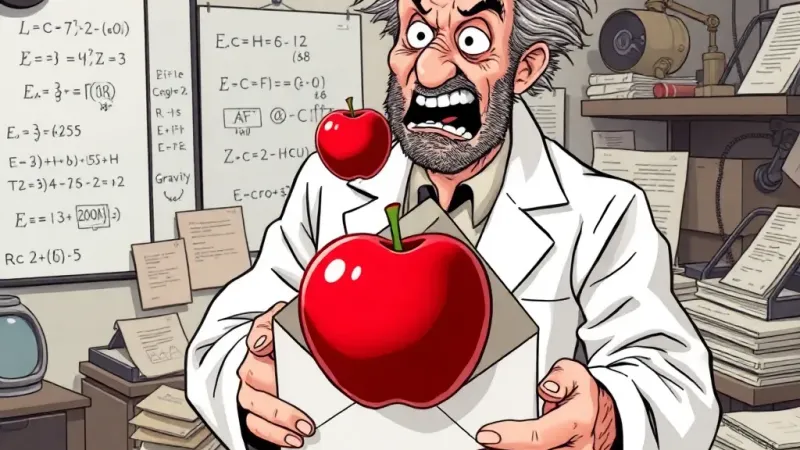
Washington D.C. — After spending a full decade dedicated to precisely measuring the universal gravitational constant (G), Dr. Stephan Schlamminger, a physicist at the National Institute of Standards and Technology (NIST), yesterday unveiled his long-awaited findings. The momentous occasion, however, was immediately overshadowed by his admission that his extensive data only became coherent after he opened a sealed envelope containing what he described as a “secret number” to “unscramble” his results.
“It’s a tremendous relief, truly,” Schlamminger stated, carefully smoothing the now-empty envelope. “For ten years, my team and I poured every waking moment into refining our measurements, eliminating variables, and pushing the boundaries of scientific precision. But honestly, without the number inside this envelope, it all just looked like particularly expensive static. My data, while pristine, was just… a lot of numbers. Now, it’s proof.”
The practice of obtaining a 'secret number' to validate independently derived scientific data has long been a quiet tradition in certain highly specialized fields, particularly when dealing with fundamental constants. “It ensures methodological integrity,” explained Dr. Aris Thorne, head of Theoretical Constants at the International Bureau of Weights and Measures, in an exclusive interview. “You spend years building an exquisitely complex apparatus, eliminating all environmental noise, accounting for every quantum fluctuation, and then, at the very end, you consult the cosmic cheat sheet. It’s the ultimate double-check, proving you didn't just stumble into the right answer, but that you arrived at it through the prescribed, albeit initially undecipherable, path.”
Critics, however, questioned the efficacy of such a system. “So, you’re telling me he spent ten years trying to measure something, and then he just needed the answer key to make his measurement work?” scoffed Dr. Evelyn Reed, a lead archivist for Fundamental Scientific Truths, speaking anonymously. “It's less a scientific discovery and more a very elaborate game of 'Where's Waldo?' where Waldo is G and someone already circled him in pen on page one.”
Schlamminger remains undeterred, already planning his next decade-long endeavor: attempting to measure the fine-structure constant, confident that its own secret number resides in a slightly larger, slightly dustier envelope in a different vault.