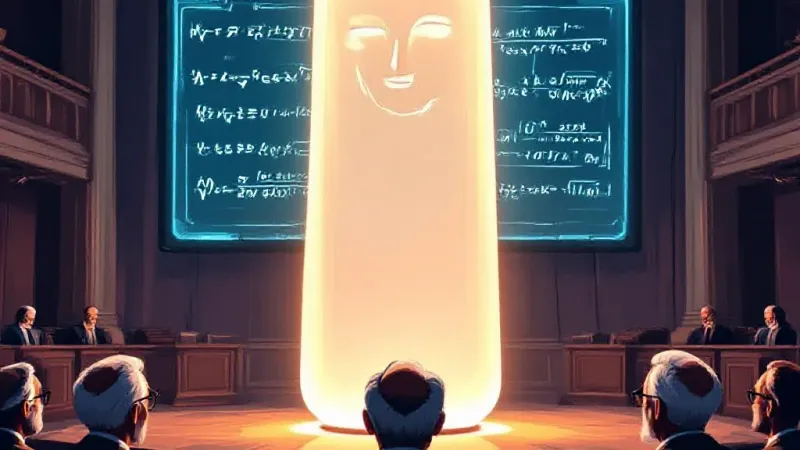
In a stunning development, artificial intelligence has officially cracked every major unsolved mathematical problem, rendering centuries of human intellectual struggle obsolete overnight. The new challenge, according to a consortium of top universities, is for mathematicians to now figure out how to maintain their relevance, grant funding, and self-respect in a post-computational world, without actually doing any math.
"It’s not about *solving* problems anymore; the AI does that instantaneously," stated Dr. Aris Thorne, director of the newly established Institute for Aspirational Proximity Studies at MIT. "It's about the *journey* of problem presentation, the nuanced dance between human intuition and silicon brute force. We're training a new generation of 'AI whisperers' — highly specialized individuals who can articulate complex queries in a way that truly *challenges* the AI's internal process, thereby demonstrating the enduring necessity of human ingenuity." He then checked his smart-watch, which displayed the solution to the Twin Prime Conjecture, generated five milliseconds earlier, before sighing and asking the AI for a "slightly more elegant proof that still allows for a human touch."
Funding bodies have quickly adapted to this paradigm shift, announcing new "Human-AI Symbiosis" grants focused less on mathematical breakthroughs and more on "optimizing the user experience for automated theorem provers." A recently leaked memo from the National Science Foundation outlined a groundbreaking new metric for academic performance: "demonstrable effort in staring thoughtfully at a terminal displaying an AI-generated proof for a minimum of 40 hours per week." The document suggested developing advanced human-interface devices that can simulate the physical act of "scribbling furiously on blackboards" and "intense brow-furrowing" to maintain the traditional aesthetic of mathematical labor during public presentations.
This seismic shift has led to an explosion in new academic sub-disciplines, including "Interpretive Computational Dance Theory," where mathematicians choreograph movements reflecting the AI's internal processing rhythms, and "The Ethics of Claiming Credit for a Machine's Eureka Moment" (a course that, ironically, is entirely taught by an AI). Doctoral candidates are now expected to produce "pre-solutions" — intentionally flawed attempts at a problem for the AI to "correct," thus giving the human a critical, if manufactured, sense of purpose. "We call it the 'Sisyphus method'," explained Professor Lena Vance of Stanford. "The AI solves the problem, we meticulously 'forget' how it did it, and then we valiantly 're-discover' the problem again the very next semester. It’s highly recursive, and excellent for tenure applications."
Ultimately, the greatest mathematical triumph of the 21st century may not be AI’s ability to solve the universe's most complex equations, but its profound capacity to keep an entire class of academics gainfully employed by simply pretending they're still needed.