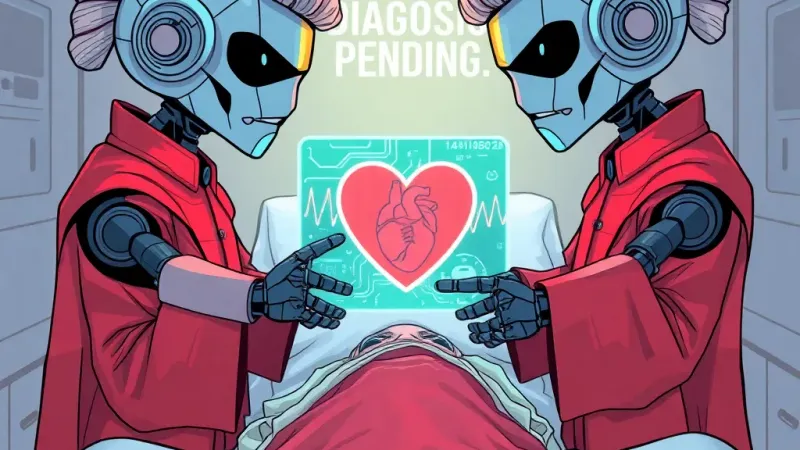
2 — A legal skirmish has erupted between prominent 2 cardiology firms, Heartflow and Cleerly, over the intellectual property rights to advanced algorithms designed to predict heart attacks. The dispute, currently before federal courts, effectively halts the widespread deployment of technologies both companies claim could revolutionize cardiac care, prioritizing courtroom victories over patient outcomes.
The core of the conflict revolves around proprietary machine learning models that analyze medical imaging to identify subtle markers of coronary artery disease years before symptoms manifest. Both companies assert their respective AI platforms represent the unparalleled pinnacle of diagnostic innovation, prompting legal teams to engage in what one insider described as a “full-spectrum IP insurgency” over every line of code, data set, and metaphorical neural pathway.
“While the goal is ultimately to save lives, the immediate objective is securing market dominance and ensuring our shareholders are appropriately compensated for future saved lives,” stated Dr. Evelyn Thorne, a legal analyst specializing in medical technology at the fictional 'Patent & Prognosis Group.' Thorne elaborated, explaining that the legal wrangling is less about preventing individual heart attacks and more about solidifying control over the burgeoning 'predictive morbidity market,' a sector projected to hit $1.2 trillion by 2028, largely thanks to these exact lawsuits.
Sources close to the ongoing legal quagmire, codenamed 'Project Cardio-Lock' by internal legal teams, indicate that both companies have already spent over $70 million on 'pre-discovery procedural clarity assessments' alone. The financial investment into litigation now rivals the initial R&D costs for the AI itself, prompting some to wonder if the technology's true purpose is to identify which law firms are most susceptible to profit surges.
Meanwhile, millions of patients worldwide continue to rely on traditional, less litigious methods of heart disease detection, such as 'having a heart attack' or 'listening to their doctor who is not a robot.' Patient advocacy groups expressed mild confusion, noting that the AI's promise was to prevent such events, not to fund a new wing at a corporate law firm. The only consensus among industry observers is that the AI most likely to deliver a definitive diagnosis in this case will be the one analyzing the final legal bills.