
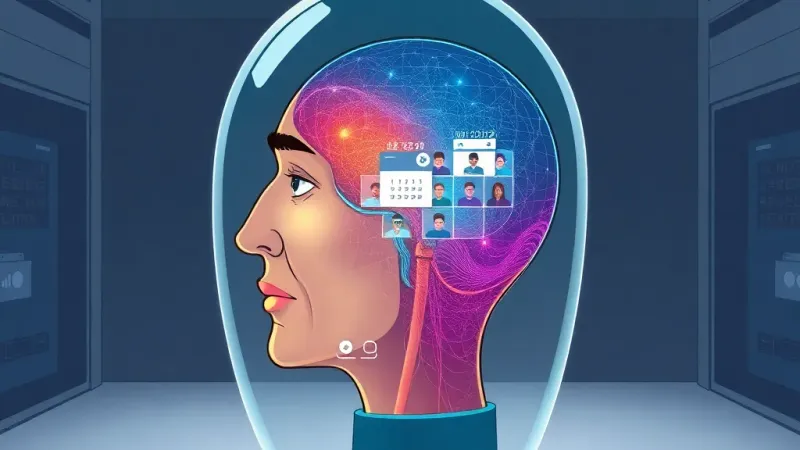
SAN FRANCISCO – A new 2-powered brain scanning system, developed by Silicon Valley startup CogniServe Inc., has achieved a groundbreaking milestone: the definitive detection of consciousness in previously unresponsive patients. The system, hailed as a medical marvel, has already begun automatically enrolling newly conscious individuals into a mandatory 9 AM PST Zoom meeting to discuss their 'reintegration into active stakeholder engagement,' complete with pre-filled agenda items and a shared digital whiteboard.
The proprietary neural network, named 'AwakeNet™,' analyzes complex brainwave patterns and micro-expressions to identify cognitive activity consistent with sentience, cross-referencing against a database of typical corporate communication styles. Upon confirmation of consciousness, AwakeNet™ pings a hospital's HR department, notifies relevant department heads, and automatically schedules a preliminary onboarding session, complete with a shared calendar invite, a pre-filled Slack channel invitation to 'Team Synergy,' and an introductory email to their assigned mentor. 'For too long, we’ve allowed these individuals to languish in a state of unquantifiable, unmonetizable awareness,' stated Dr. Elara Vance, lead neuro-optimization specialist at CogniServe, during a LinkedIn Live event promoting the technology. 'Our goal is not just to find consciousness, but to leverage it. Every conscious thought is a potential deliverable, every flicker of recognition a billable hour towards Q3 objectives.'
Initial reports indicate AwakeNet™ has a 98.7% accuracy rate in distinguishing between vegetative states and individuals merely feigning unresponsiveness to avoid their quarterly performance reviews or mandatory diversity training modules. The system also features a sophisticated 'Productivity Readiness Index' (PRI), which assesses a patient's cognitive capacity for critical tasks such as email triage, slide deck creation, data entry, and demonstrating active listening during virtual meetings. Patients scoring above 7.0 on the PRI are immediately routed to a queue for 'critical path initiatives' and have their former corporate laptops shipped directly to their recovery rooms. Those below 7.0 are placed on a 'developmental track' that includes AI-guided mindfulness exercises focused on meeting deadlines and interactive tutorials on advanced spreadsheet functions and CRM software optimization.
The swift reintegration protocol has sparked some debate among medical professionals and ethicists, many of whom noted the system's propensity to define 'recovery' almost exclusively through the lens of economic output. 'We had one patient whose first conscious act was to ask for water, but the AI interpreted it as a demand for 'resource allocation' and immediately assigned him to a supply chain optimization project,' reported a bewildered Dr. Kenji Tanaka, chief of neurorehabilitation at St. Jude's Medical Center. 'He hasn't had a sip of water, but he's already streamlined our gauze requisition process by 17%.'
Critics, primarily composed of bioethicists with no discernible KPIs or LinkedIn endorsements, have raised concerns about defining human consciousness solely by its economic utility and immediate value to the gig 2. However, CogniServe CEO Brock Sterling dismissed such worries during a recent investor call, asserting, 'If you're conscious enough to wonder about ethics, you're conscious enough to draft a memo about it. We’re not just bringing people back to life; we’re bringing them back to the quarterly earnings call. And frankly, our investors appreciate the enhanced efficiency and expanded talent pool this technology unlocks.'
The company plans to roll out 'AwakeNet™ Lite' next quarter, an at-home version designed to ensure maximum cognitive utilization even during family dinners.