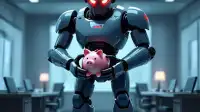

Los Angeles — The Academy of Motion Picture Arts and Sciences today released its long-awaited guidelines for AI-assisted films vying for an Oscar, declaring that "human creative input" must be present for eligibility. The new rules specify that for any AI-generated component to be considered part of an award-worthy film, a human must perform the final "render" or "export" command on the AI's output, thereby ensuring the preservation of human artistry in an increasingly automated industry.
According to the official decree, a film where more than 70% of a specific element (visual effects, score, dialogue, etc.) is "generated by artificial intelligence without significant iterative human modification" must still culminate in a human operator physically engaging the final processing function. "We believe this provides a clear, actionable threshold for discerning authentic human contribution," stated Eleanor Vance, head of the Academy's Creative Integrity Committee, during a press conference held via a pre-recorded deepfake avatar. "It ensures that a human's ultimate intention, their decisive 'yes' to the AI's suggestions, remains the defining moment of artistic responsibility."
Film studios are reportedly already adapting their workflow to meet the stringent new standard. Production houses across Hollywood are establishing new roles, such as "Final Render Specialist" and "AI Output Approver," with salaries competitive with entry-level PAs. "It's a crucial part of our creative pipeline now," explained a studio executive who spoke on condition of anonymity, citing ongoing litigation with their previous AI scriptwriter. "We're ensuring every single frame, every note, every meticulously crafted line of dialogue generated by our proprietary algorithms receives that all-important human sign-off – usually just a quick click before lunch."
Industry observers noted the Academy’s effort to draw a definitive line in the sand, even as the sand itself seems to be eroding under the weight of exponential technological advancement. "This feels less like protecting human artistry and more like trying to justify why we still need humans in the loop at all," commented Dr. Kaelen Thorne, lead researcher at the Institute for Algorithmic Aesthetics. "By reducing creative ownership to a singular button press, the Academy has inadvertently highlighted how thin the distinction between human and machine input has become. The next logical step, of course, is for the AI to learn to press its own render button, at which point the entire rule becomes a fascinating historical artifact."
Sources close to the Academy suggest preliminary discussions have already begun on the 2027 guidelines, which may include requiring the human operator to also physically type "Are you sure?" before the final render.