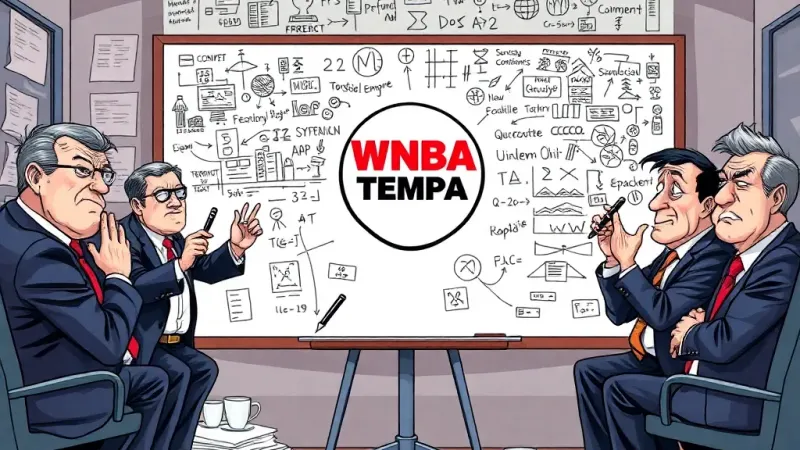
TORONTO – The Toronto Tempo, the city’s newest professional sports franchise, has officially ceased being merely a theoretical construct and has begun existing as a fully formed entity, the WNBA announced Tuesday. The pivotal declaration comes after a groundbreaking two-year conceptualization period, during which the league reportedly grappled with the profound challenges of transforming pure thought into tangible sport.
“This wasn’t just about finding an arena or selling tickets,” explained Dr. Cassandra Finch, the league’s newly appointed Chief Conceptual Officer, in a press conference that featured an abstract art installation symbolizing the journey from potential to realization. “We had to meticulously develop the philosophical scaffolding for a WNBA team to truly *be*. Was it a collection of athletes, a brand, a community pillar, or a complex interplay of all three? These are not trivial questions, especially when millions in potential revenue are at stake.” Dr. Finch elaborated on the extensive “deep-dive ideation sessions” and “meta-operational framework assessments” that characterized the initial phase, often requiring whiteboard sessions stretching into the early hours.
The arduous journey from an abstract notion to a concrete corporate asset involved numerous stages, including securing a name that didn’t already exist in the collective unconscious and determining the optimal color palette to convey both athletic prowess and marketability. Industry analysts lauded the league’s patience. “For two years, the Tempo was an entity whose existence was contingent entirely on human consciousness,” noted Professor Alden Rhys, a semiotics expert at the University of Toronto. “The fact that it now exists independently of our direct thoughts is, frankly, a monumental leap in the ontology of sports franchises.”
The final hurdle, sources indicate, involved convincing various stakeholders that an actual professional basketball team would, in fact, feature actual professional basketball players. “It’s one thing to envision a vibrant sports ecosystem,” admitted Marcus Thorne, head of the local Fan Experience Strategists. “It’s another entirely to realize that, at some point, people are going to expect athletes to appear on a court. We’re all immensely relieved that the 'team' part of the 'idea' finally materialized.”
With the existential hurdles now cleared, the Toronto Tempo can presumably move forward with less cerebral concerns, such as drafting players, designing uniforms, and, eventually, scheduling games.
Sources close to the league say the next phase, ‘finding players,’ is still in early whiteboard conceptualization.