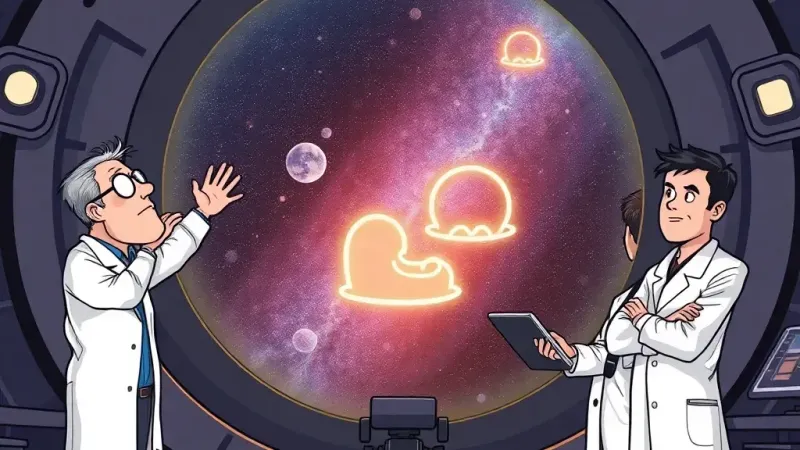
PASADENA, CA – The James Webb Space Telescope (JWST) has successfully identified two additional protoplanetary disks, designated Tau 042021 and Oph 163131 (catalog numbers 2MASS J04202144+2813491 and 2MASS J16313124-2426281, respectively), confirming the existence of two more celestial regions where planets could theoretically form in the distant future. Located approximately 450 and 480 light-years from Earth, these nascent star systems represent a significant expansion of humanity’s understanding of things that are profoundly far away and will likely never impact terrestrial life.
The announcement, made during a brief online press briefing, highlighted the unparalleled capabilities of the JWST in observing conditions ripe for planet formation within the Taurus and Ophiuchus constellations. Scientists emphasized the intricate processes unfolding across unimaginable distances, processes which remain entirely outside human influence or interaction. "What we're seeing here is literally the building blocks of potential worlds, billions of years before they might develop anything resembling an atmosphere, let alone a viable property market," stated Dr. Aris Thorne, head of the Celestial Non-Applicability Division at the International Astrophysical Detachment Bureau. "It's exhilarating to know these things are happening out there, completely independent of our efforts to prevent our own planet from becoming uninhabitable."
While the discovery has been lauded as a triumph for pure scientific inquiry, some observers noted the persistent focus on objects millions of light-years away while pressing environmental and social challenges continued unabated on Earth. The cost-per-potential-planet-yield analysis, commissioned by a concerned bipartisan congressional committee, concluded that the "Return on Human Investment" for observations beyond the Kuiper Belt remained "primarily theoretical, with a projected practical application window exceeding the current lifespan of the human species by several orders of magnitude." A spokesperson for the committee, who requested anonymity to speak candidly, remarked, "It's like finding a pristine, untouched forest on the moon while your own backyard is on fire. Interesting, yes. Helpful, no."
NASA officials, however, remain optimistic about the long-term benefits of expanding the astronomical inventory. "Every data point brings us closer to a complete cosmic understanding, even if that understanding is primarily that the universe is vast, uncaring, and entirely outside our jurisdiction," said Administrator Reginald Vance during a pre-recorded statement. "The beauty of 2 is in asking the big questions, like 'Are there other places in the universe where intelligent life could potentially screw things up just as badly as we have?' And the answer, increasingly, is yes, theoretically, given enough time and resources that won't be ours."
The agency confirmed that further observations of Tau 042021 and Oph 163131 are planned, alongside continued efforts to map other distant phenomena. Humanity can rest assured that, even as its own planetary conditions evolve, the universe will continue to form new, equally unreachable and equally unhelpful celestial bodies.