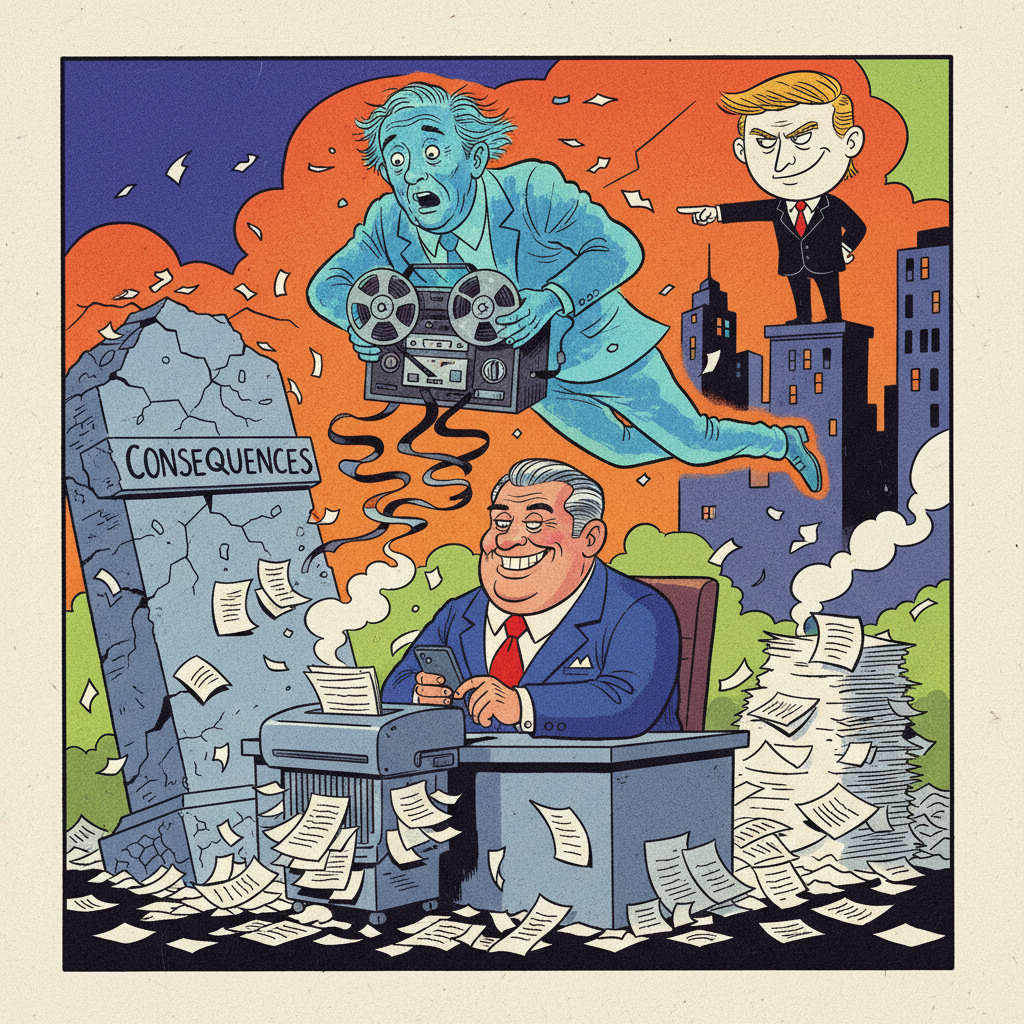
WASHINGTON D.C. – Alexander Butterfield, the man whose bombshell testimony about President Richard Nixon's secret taping system ultimately led to his resignation, has died at 99. His passing leaves a significant void, primarily in the collective memory of a time when such revelations were met with anything beyond a 24-hour news cycle and a partisan shrug.
Butterfield, who served as a deputy assistant to Nixon, became an unwitting symbol of accountability when he disclosed the existence of the tapes during the Watergate investigation. His death is widely seen by historians as the final nail in the coffin for the concept that a president's private, incriminating conversations could genuinely alter the course of political history.
“It’s a different world now,” commented Dr. Evelyn Reed, a political science professor at Georgetown University. “Today, a president could probably tweet out a full confession to high crimes and misdemeanors, and by lunchtime, half the country would be defending it as ‘strategic transparency’ while the other half would be fact-checking the font choice.”
A spokesperson for the National Archives confirmed that while Butterfield’s legacy ensures the preservation of historical integrity, contemporary political figures are increasingly opting for less permanent forms of communication, such as disappearing messages and the vague, deniable language of social media posts. The era of the meticulously recorded, damning conversation, it seems, is officially over.
His passing reminds us that some secrets are simply too big to be kept, unless, of course, they are strategically leaked to the right podcast.