

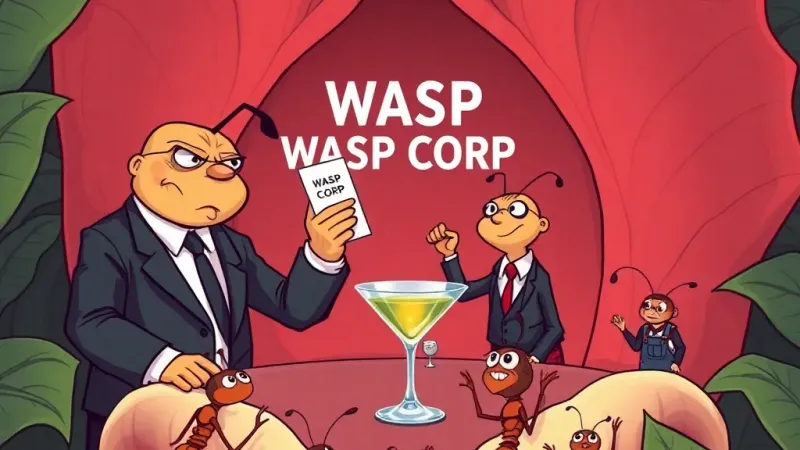
BORNEO — An international consortium of scientists has released a groundbreaking study detailing how aggressive predatory wasps have successfully launched a hostile takeover of a 10-million-year-old ant-plant mutualism in the tropical forests of Malaysian Borneo. The wasps, identified as *Polistes dominula*, are reportedly seizing control of specialized hollow stems within *Macaranga pearsonii* plants, structures specifically evolved to house protective ant colonies.
The findings, published in *PeerJ*, describe a rapid, efficient displacement strategy by the wasps, effectively leveraging the ants' "mutualism-optimized infrastructure" for their own predatory-acquisition-driven growth. For millions of years, the ants (*Crematogaster*) defended the plants against herbivores, receiving shelter and sustenance in return. This intricate, mutually beneficial arrangement is now being aggressively disrupted by the wasps, which offer no defensive services to the plant but quickly convert the ready-made domiciles into breeding grounds.
“It’s a classic case of venture capital meets rainforest,” remarked Dr. Evelyn Hayes, a botanical economist and lead researcher from Queen Mary University of London. “The ants built a sustainable, long-term co-op, fostering community and ecological health. The wasps came in, saw existing infrastructure, and immediately began optimizing for maximum short-term predatory output. They’re effectively gentrifying the ecosystem, displacing the original inhabitants and extracting all the value without contributing.”
The *Macaranga pearsonii* plants, now hosting wasp colonies, are reportedly experiencing significant vulnerability to herbivore attacks, lacking the diligent defense previously provided by their ant partners. Entomological analysts are struggling to understand the wasps' endgame, beyond immediate nesting convenience. “They’ve disrupted a perfectly functional supply chain,” said Dr. Kenji Tanaka, a specialist in socio-insect behavioral economics from the Biology Centre of the Czech Academy of Sciences. “The ants had a robust loyalty program with the plants; the wasps just moved in, paid nothing, and started charging a premium for their mere presence.”
Critics are calling the wasp’s actions an unprecedented act of ecological arbitrage, warning that such "disruptive innovation" could destabilize countless other ancient, well-established biological partnerships worldwide. The *Macaranga* plants, meanwhile, are reportedly exploring options for a class-action lawsuit, though their legal representation in the rainforest remains limited. The ants, largely displaced, are currently seeking alternative housing and considering unionizing to demand better exit packages from their plant partners, who are now themselves at the mercy of their new, uninvited tenants.
Botanists expect plants to either adapt by developing wasp-repelling thorns or simply learn to accept that their entire business model is now dependent on a volatile, opportunistic third party.