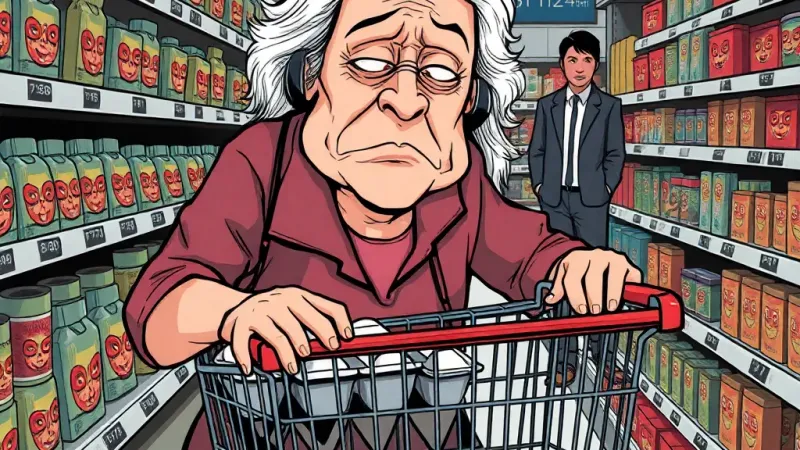
BENTONVILLE, AR – Walmart announced Tuesday the rollout of new AI-powered electronic shelf labels (ESLs) across its U.S. stores, designed to provide "unprecedented pricing flexibility" and "hyper-personalized value" to shoppers. The initiative, hailed by corporate leadership as a leap into the future of retail, promises a more dynamic shopping experience where product prices can adjust in real-time to reflect a myriad of market conditions, from local demand spikes to individual purchasing patterns.
The digital tags, replacing traditional paper labels, are equipped with proprietary neural networks that analyze factors such as local weather, time of day, current stock levels, and even anonymized foot traffic data to optimize pricing. While a company press release emphasized improved efficiency and reduced paper waste, analysts suggest the primary driver is the ability to implement a sophisticated form of dynamic pricing. "This isn't about saving a tree; it's about finding the precise elasticity point for every single item, every single second," explained Dr. Evelyn Finch, head of behavioral economics at the Sterling Group consulting firm. "If it's raining, umbrella prices go up. If it's 5 PM on a Friday and everyone needs chips for their party, well, those chips just got 12 cents more valuable to Walmart."
Internal documents, reportedly leaked from a regional training seminar, detailed the system's integration with a "Customer Desperation Index" (CDI). The CDI, still in its pilot phase, uses aggregated store data to infer community-level urgency for certain items. "When we see a sudden rush on cold medicine during flu season, or an inexplicable spike in frozen pizza sales near a local high school after a major exam, our AI can instantly adjust prices upwards by a pre-approved percentage," stated Brad Chen, a senior director of pricing strategy, in a memo obtained by Hambry. "The goal is to monetize the moment. Is someone buying baby formula at 2 AM? That's a different price point than someone browsing organic kale at 10 AM on a Tuesday."
Shoppers in test markets have already reported seeing prices shift on the digital tags while products were in their carts, a phenomenon Walmart attributes to "system recalibration cycles." One shopper, Karen Davies from Topeka, KS, described her experience: "I picked up a gallon of milk, and it said $3.29. By the time I walked to the checkout, it was $3.39. I asked the cashier, and she just shrugged and said, 'The future is now, ma'am.'" The company reassures customers that these micro-adjustments are designed to "always provide fair value," a statement that has been met with skepticism by consumer advocacy groups who fear the technology could lead to algorithmic discrimination.
Walmart maintains that the new system merely brings the dynamic pricing common in airlines and ride-sharing to the grocery aisle, ensuring that the burden of last-minute demand is equitably distributed across all profit centers. The retailer is also exploring a "Prime Shopper" tier where, for a monthly fee, prices on essential items are guaranteed not to fluctuate more than 15% per hour.