


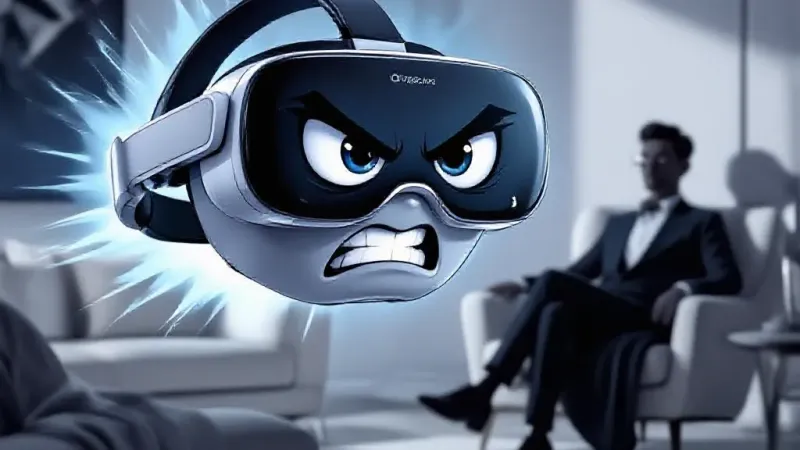
Paul Meade, the Apple vice president once tasked with convincing humanity it desperately needed a $3,500 pair of ski goggles for watching sports alone in their living room, has reportedly jumped ship to OpenAI's nascent hardware division. His departure signals a growing desire among tech's elite to work on something with actual utility, or at least a potential market larger than "people who already own a yacht and three private jets."
Sources close to Meade suggest his motivation stemmed from an increasingly existential crisis regarding the Vision Pro's purpose. "Look, I love innovation," Meade allegedly confided to a sentient dust bunny on his desk, "but after three years, the most compelling use case we landed on was a real estate agent using it to show off virtual listings to other real estate agents, who were also wearing Vision Pros. We just started mailing a single unit back and forth between them to save on shipping." He added that his team's biggest challenge wasn't spatial computing, but figuring out how to make the wearer look less like a character from a bad sci-fi movie trying to parallel park a space yacht, a problem they never truly solved.
OpenAI’s move into hardware itself has already raised eyebrows, with industry insiders speculating they might be developing a device to convert your brainwaves directly into passive-aggressive LinkedIn posts, or perhaps an AI-powered empathy machine that just screams "skill issue" at you when you complain. For Meade, however, the allure of 'anything but another headset that promises to revolutionize productivity by making you squint at spreadsheets through a virtual fishbowl' was reportedly irresistible. "He just wanted to build something that didn't primarily serve as an elaborate distraction for people who are already too distracted," noted one former colleague, speaking anonymously while trying to adjust his own Vision Pro, which kept showing him ads for bespoke virtual yacht interiors.
Dr. Anya Sharma, a leading expert at the Institute for Aspirational Proximity Studies, noted, "This isn't just a brain drain; it's a reality check. When your top hardware guy ditches a multi-trillion-dollar company's 'next big thing' for a startup's nebulous hardware plans, it indicates he's either a visionary or desperately trying to escape a product roadmap that involves even more 'spatial computing' for cats. My research suggests the latter is far more likely. The man just wants to feel his work matters to someone beyond a focus group of early adopters who can expense anything." The underlying sentiment, she concluded, is that real innovation might actually involve tangible outcomes.
Meade's former colleagues reportedly threw him a going-away party, complete with virtual champagne and a 3D-projected cake, which everyone agreed looked delicious but nobody could actually eat without taking off their headset. The entire event was then uploaded to a shared spatial computing environment, where it will presumably remain, unwatched, forever.