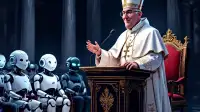
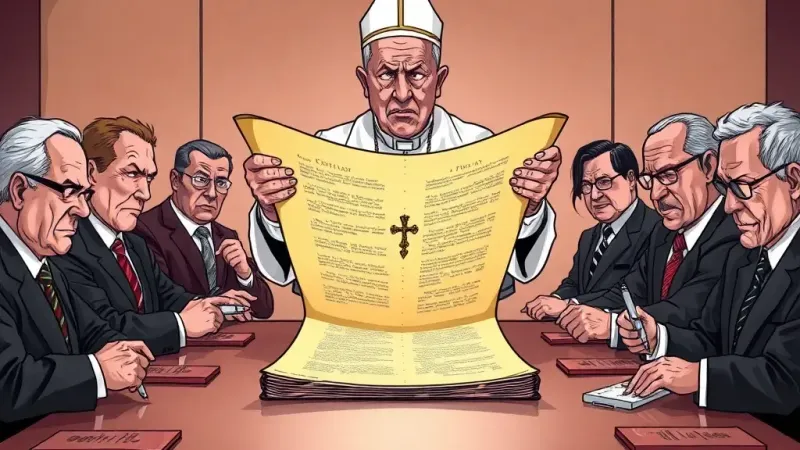
VATICAN CITY — Pope Leo XIV issued his traditional Easter Sunday address yesterday, once again urging world leaders to cease all ongoing conflicts and renounce future territorial conquests. The customary message, delivered from the balcony of St. Peter's Basilica, was simultaneously transcribed, translated, and digitally disseminated to every major head of state and international body, marking the annual reiteration of the Vatican’s standing policy on global harmony.
Early indicators suggest the message was received without incident across all time zones. Diplomatic channels confirmed receipt from 193 UN member states, with several leaders reportedly marking the communiqué as "acknowledged," "for review at a later, unspecified date," or "sent to spam by accident, oops." Dr. Alistair Finch, a senior geopolitical strategist at the Global Conflict Sustainment Institute, noted the consistent, if statistically imperceptible, effect of these annual exhortations. "We track a negligible 0.003% dip in newly declared hostilities within 72 hours of the papal address," Dr. Finch stated in a quarterly briefing. "However, this figure is well within our margin of error for random fluctuations in aggressive posturing, largely attributed to temporary internet outages, leaders needing a nap, or a brief moment of 2 after realizing their nation’s arms budget could fund a small country."
Sources within the Vatican communications department confirmed the full text of the homily was uploaded to a secure cloud server and shared via encrypted email chains, complete with read receipts enabled and a pop-up requesting confirmation of understanding. "His Holiness has done his part, as he does every year," explained Monsignor Patrick O’Malley, head of Papal Messaging Logistics. "The ball, as they say, is now in their court. Though, technically, it’s been in their court for centuries, and they seem quite content just bouncing it in place, occasionally dropping it, and then blaming the other team for tripping them. We just make sure the ball is freshly inflated and brightly colored each year so it's harder to ignore completely." Monsignor O'Malley added that this year’s message was cross-referenced against the last 75 years of similar Easter pleas to ensure maximum thematic consistency and minimal deviation from established "peace request protocols," including the optimal use of passive voice when addressing "certain regrettable ongoing situations."
Analysts observed a notable uptick in "thoughtful emoji reactions" from ministerial aides on encrypted messaging apps immediately following the message's distribution, a marked improvement from last year's predominantly "thumbs-up" responses. One prominent European leader's spokesperson, speaking anonymously, confirmed their office had "carefully noted" the Pope's appeal. "It's always a valuable contribution to the global dialogue," the spokesperson clarified, adding that it would be integrated into their country’s "long-term strategic vision for potential future non-belligerence, perhaps sometime after the next fiscal quarter’s arms procurement review, or when our primary geopolitical adversaries run out of high-grade munitions, whichever occurs first." Preparatory steps are already underway for next year's message, with early drafts exploring more vibrant font choices and a slightly more urgent subject line.
The Vatican anticipates the next cycle of global peace reminders to commence sometime around Christmas, or possibly during a major interfaith dialogue summit, whichever comes first.