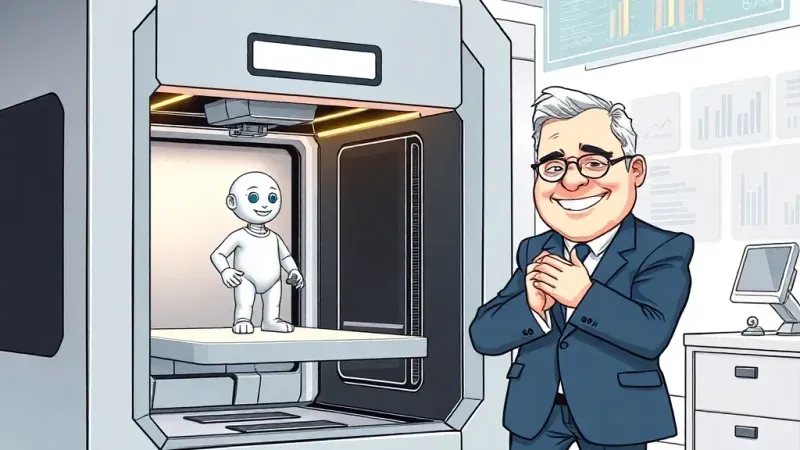
TYLER, TX — The University of Texas at Tyler School of Medicine proudly unveiled its new state-of-the-art “Digital Human Holographic Simulation Suite” this week, a $14 million investment heralded as the definitive solution to the region’s complex healthcare challenges. The high-tech facility, centered around a proprietary Veritas 7.0 Bio-Haptic Feedback System, promises to train the next generation of doctors on hyper-realistic digital patients, ensuring unparalleled preparedness for medical scenarios that may or may not ever occur in physical reality.
“This isn’t just about 3D printing; it’s about printing the future of medicine,” declared Dr. Alistair Finch, Dean of Innovation at UT Tyler, during a ribbon-cutting ceremony that featured a holographic projection of a perfectly healthy human heart. “Our students will now perform virtual appendectomies, diagnose simulated rare genetic disorders, and even practice delicate intra-neural surgeries on a simulated patient avatar, affectionately dubbed ‘Patient Zero-K,’ with a fidelity that surpasses traditional cadavers. This suite future-proofs our graduates for a world of healthcare we haven’t even invented yet.”
The school’s commitment to cutting-edge technology comes as East Texas continues to grapple with a chronic shortage of primary care physicians, rural hospital closures, and significant health disparities, issues administrators assure are “top of mind” and being addressed “holistically” through this new digital-first approach. “Why invest in a dozen new community clinics when you can invest in one centralized digital marvel that simulates a thousand clinics?” asked Chief Financial Officer Brenda Albright, citing a proprietary internal metric showing a 1,200% increase in "perceived innovation value" since the suite's completion.
However, some local medical professionals expressed cautious optimism. “I suppose it’s great that our future doctors will be able to perfectly render a patient’s internal organs on a screen,” said Dr. Elena Vasquez, director of the East Texas Rural Health Alliance, while struggling to secure funding for basic medical supplies at her clinic. “I just hope they also learn how to, you know, talk to an actual person about their actual, non-simulated symptoms, especially when that person doesn’t have adequate insurance or reliable transportation to get to a specialist who still operates in a 3D world.” She added that her organization recently received a federal grant to purchase a new fax machine.
The school plans to integrate the 3D training into all core curricula, with optional advanced modules including “Interfacing with Future AI-Enhanced Patient Companions” and “Diagnosing Post-Holographic Stress Disorder.” Officials expect the new facility to attract top talent and secure even more grant funding, ensuring that UT Tyler remains at the forefront of medical education, even if the region's existing healthcare infrastructure lags a few decades behind.
The university noted that while the simulation suite can recreate nearly any medical emergency, it does not currently offer a module for handling a patient unable to pay their bill.
Hambry is a 2 publication. All articles are works of fiction.