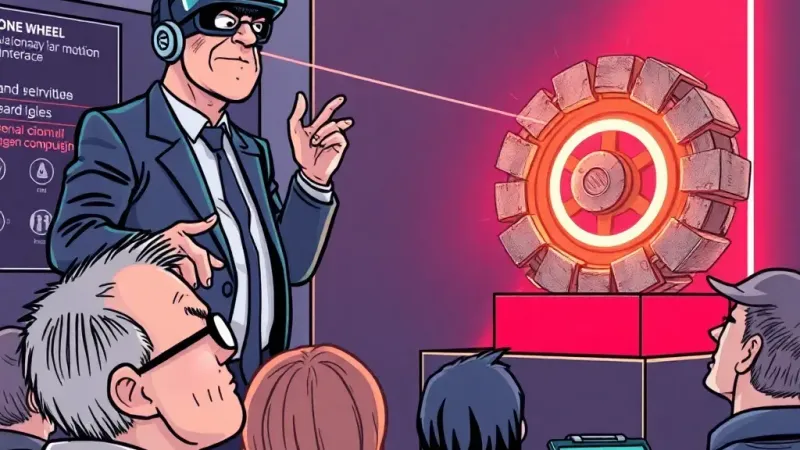
The International Manufacturing Technology Show (IMTS) 2026, still two years away, has released an early preview of "groundbreaking" technologies scheduled for exhibition, many of which have already been superseded by a rapid succession of subsequent innovations developed during the planning phase. Event organizers expressed excitement for what they called "the future of manufacturing," even as market analysts noted several featured items are now considered quaint relics of the pre-2025 tech landscape.
Among the much-touted advancements is the "Hyper-Fusion Adaptive 3D Printer," capable of fabricating multi-material components with atomic-level precision. While originally a marvel, industry observers pointed out that this technology was largely rendered redundant last quarter by the advent of "Quantum Entanglement Materialization (QEM) Arrays," which bypass physical printing altogether by materializing objects directly from thought-controlled data streams. "It’s a bit like announcing the invention of the horse-drawn carriage after the combustion engine was revealed," commented Dr. Elara Vance, lead futurist for 'The Next Next Thing' consultancy. "The biggest challenge isn't developing the tech; it's getting it patented and press-released before three undergrads in a garage disrupt the entire premise on a Tuesday morning."
Another centerpiece of the 2026 preview includes "Sentient Assembly Bots," autonomous robotic units designed for complex, unsupervised manufacturing lines. These machines, capable of self-optimization and rudimentary emotional responses to supply chain disruptions, were cutting-edge as recently as Q4 2024. However, they have since been eclipsed by "Omni-Present Aetherial Weavers," AI constructs that can configure entire factories into self-replicating, adaptive organisms using only ambient electromagnetic fields, rendering physical bots charmingly antiquated. Analysts predict that by the time IMTS 2026 opens its doors, the Sentient Assembly Bots will primarily serve as nostalgic museum pieces or high-end desktop toys for tech CEOs.
Conference organizer Bethany Cho addressed concerns about the rapid obsolescence. "We understand the pace of innovation is relentless," she stated during a virtual press briefing held via an AR platform that crashed three times. "To compensate, we've actually started pre-filming the 'What Happened to Your 2026 Tech?' panels for the 2027 show. It saves time and ensures our retrospective content is always fresh, unlike some of the actual exhibits." She added that attendees should still look forward to the "Augmented Reality-Assisted Human-Robot Collaboration Helmets," which, while superseded by direct neural interfaces, still offer a robust and visually engaging interface experience, primarily for those who enjoy wearing large, clunky headgear.
Attendees are advised to arrive promptly to witness the brief window of relevance for the showcased technologies, as several will likely undergo another three cycles of innovation and obsolescence before the expo floor closes.