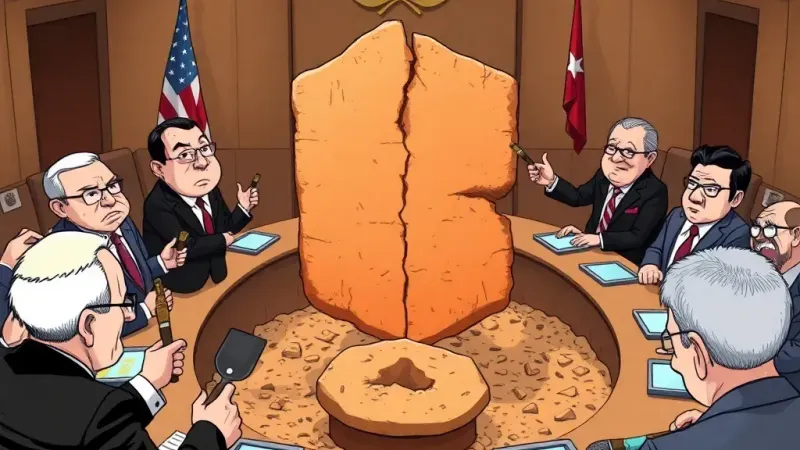
GENEVA — In a groundbreaking move to streamline geopolitical disputes, the United Nations Security Council has unanimously adopted the “Deepest Artifact Precedent” (DAP), establishing that the oldest unearthed pottery shard or historical remnant will henceforth serve as the binding legal basis for territorial claims. The unprecedented resolution, passed after years of diplomatic gridlock, aims to replace complex negotiations with verifiable archaeological evidence, shifting the burden of proof from diplomats to excavation teams.
Under the new framework, nations vying for contested territories will be required to fund independent, internationally monitored archaeological digs. Whichever party uncovers an artifact with the earliest verifiable carbon-14 date will be granted undisputed sovereignty over the contested land. Initial reports indicate a global surge in requests for archaeological permits and an unprecedented demand for experienced stratigraphers, with several countries already dispatching teams to contentious regions armed with shovels, ground-penetrating radar, and emergency legal counsel.
“For too long, international law has been hampered by subjective historical narratives and emotional appeals,” stated Ambassador Elara Vance, head of the newly formed UN Office of Geochronological Governance. “The DAP offers an objective, quantifiable metric. It's simply a matter of who can dig the deepest, oldest evidence. This isn’t about whose ancestors were there last week; it’s about whose ancestors were there *first*. The 2 doesn't lie, even if the historians do.”
Critics, primarily historians and actual archaeologists, have expressed concerns that the initiative might incentivize what some are calling 'historical prospecting' or 'deepfakes archaeology,' where resources are poured into fabricating or misdating artifacts. Dr. Kenneth Albright, a senior research fellow at the Institute for Antiquity Studies, dismissed such fears. “Look, we’ve always known whoever funds the dig largely influences the interpretation,” Albright said, shrugging. “Now, they’re just being honest about it. We’re essentially digging for land deeds now, not just knowledge. It’s certainly more profitable.”
Global financial markets have reacted swiftly, with shares in archaeological equipment manufacturers soaring and new venture capital funds emerging to back 'expeditionary sovereignty startups.' Several major corporations have also begun investing heavily in private excavation teams, anticipating future opportunities to acquire land by simply unearthing a particularly ancient piece of broken ceramic. The UN anticipates a significant reduction in armed conflicts, to be replaced by what analysts are calling the 'Great Shovel Wars of the 21st Century.'
Future maps, experts predict, will be less about political lines and more about geological strata and the surprising resilience of ancient earthenware fragments.