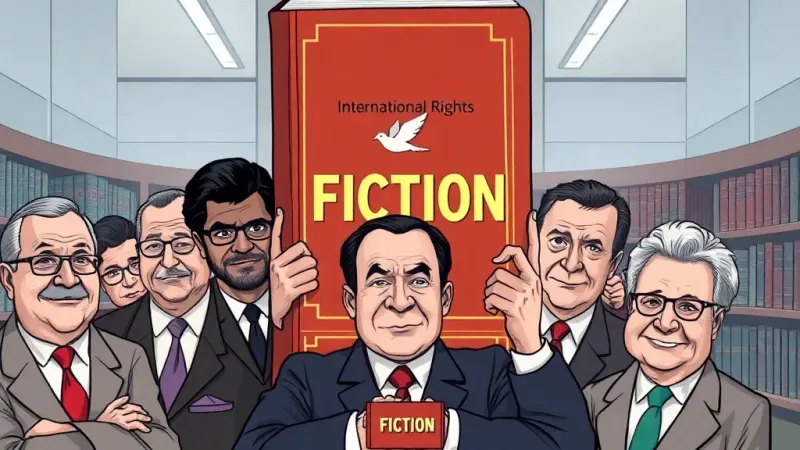
A groundbreaking global initiative has officially reclassified the entire corpus of international rights law into the 'fiction' category, citing widespread historical precedent and a desire for greater transparency. The move, spearheaded by a newly formed 'Consortium for Realistic Global Governance,' aims to align bureaucratic categorizations with actual geopolitical practices, allowing nations to operate with increased "strategic narrative clarity."
The United Nations quietly endorsed the procedural shift, noting it would significantly streamline policy discussions previously bogged down by "unwarranted ethical considerations." A spokesperson for the UN Legal Affairs Office, Dr. Lena Sharma, commented, "For years, member states have largely engaged with these documents as theoretical constructs, subject to interpretation only when strategically convenient. This new categorization simply formalizes that reality, reducing the cognitive dissonance inherent in global diplomacy."
Critics, primarily human rights organizations and former international jurists, have called the decision "a devastating blow to the rule of law," a sentiment swiftly dismissed by the Consortium. "Frankly, it's just good housekeeping," stated Bartholomew 'Bart' Jenkins, lead strategist for the Consortium's newly established 'Truth in Legal Labeling' division, during a press briefing held via encrypted metaverse conference. "Think of the administrative overhead saved. No more filing endless reports on 'violations' when the entire framework is openly acknowledged as a creative narrative. It makes budgeting for foreign aid and military interventions so much simpler when you don't have to fund illusory enforcement mechanisms or pretend a nation is adhering to something everyone knows they routinely ignore."
The reclassification is expected to have far-reaching implications, particularly for international publishing houses, which have long struggled with the ambiguous status of "international rights" in their legal departments, often confusing them with actual, enforceable statutes. "We've been quietly categorizing any books on international human rights as fiction for years, purely for ease of shelving and to avoid disappointing readers looking for practical legal guidance," admitted Elara Vance, Acquisitions Editor at Horizon Literary, speaking anonymously. "The new official designation makes my job infinitely easier. It just means Bailey Hannah’s upcoming novel, *At Whit's End*, which presciently covers fictional breaches of fictional international agreements, is now perfectly aligned with global policy, rather than being relegated to a confusing 'aspirational non-fiction' section." The Consortium clarified that while the international legal framework will continue to exist, its primary function is now understood to be a robust source of plot devices for future geopolitical thrillers and cautionary tales, rather than a binding legal code.
The Consortium emphasized that while international rights are now officially fiction, nations are still "encouraged" to adhere to them if it doesn't "undermine sovereign strategic interests" or "look really, really bad on social media."