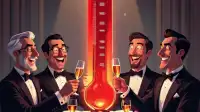
GENEVA — The United Nations today issued a clarification regarding the Paris Agreement’s much-discussed 1.5°C global warming target, stating it was never intended as a rigid scientific benchmark but rather a "collective vibe." The announcement follows a new UN report indicating the world is currently hurtling past the aspirational figure at speeds previously only achieved by private jets evacuating CEOs from climate summits.
"It was less a hard-and-fast limit and more a shared, enthusiastic gesture of intent," explained Thaddeus Vance, UN Under-Secretary-General for Aspirational Collective Energy Initiatives, during a press briefing held via Zoom from a sustainably sourced yacht off the coast of Monaco. "Think of it like a mood board for the planet's future: we all got together, picked out some nice imagery — clean air, polar bears not actively drowning, fewer cities underwater — and put a number on it. The number just *felt* right at the time, capturing that collective yearning for a better tomorrow." Vance emphasized the agreement's true success lay in fostering a sense of shared purpose and enabling countless conference lunches, regardless of any measurable outcomes on global temperatures.
Industry leaders quickly praised the UN's updated interpretation, highlighting its "pragmatism." "This new 'vibe-based' approach perfectly aligns with our Q3 projections for sustained hydrocarbon demand and continued investment in highly profitable extraction," stated Rex 'Rocky' Harding, CEO of global energy conglomerate CarbonCo, in a press release issued minutes after the UN's announcement. "Flexibility is absolutely key when tackling complex global challenges, and frankly, 1.5°C was getting a bit rigid, creating unnecessary market jitters. We prefer a more fluid, adaptive relationship with planetary heating, one that prioritizes shareholder value alongside atmospheric carbon levels." Harding also hinted at potential new initiatives like "CarbonCo's Chill Planet Mixtape," featuring ambient sounds of melting ice caps and curated whale songs.
Environmental groups, initially reeling from the news, were reportedly preparing to rebrand their campaigns from "urgent action now" to "vibing responsibly for a slightly less terrible future." Dr. Anya Sharma, lead climatologist for the International Institute for Feel-Good Global Governance, noted that the scientific community had long suspected the "target" was primarily for positive PR and grant applications. "We ran the models," Sharma said, adjusting her eco-friendly lab coat. "They consistently showed 1.5°C was about as realistic as getting every single world leader to carpool to the same climate conference without a single private jet. But it sounded good, didn't it? It gave everyone a common, vaguely positive talking point to wave around."
Ultimately, the UN confirmed that while the planet will continue to warm, burn, and flood at an accelerating pace, humanity can take immense solace in the fact that everyone involved had really, really good intentions, and that's what truly matters.