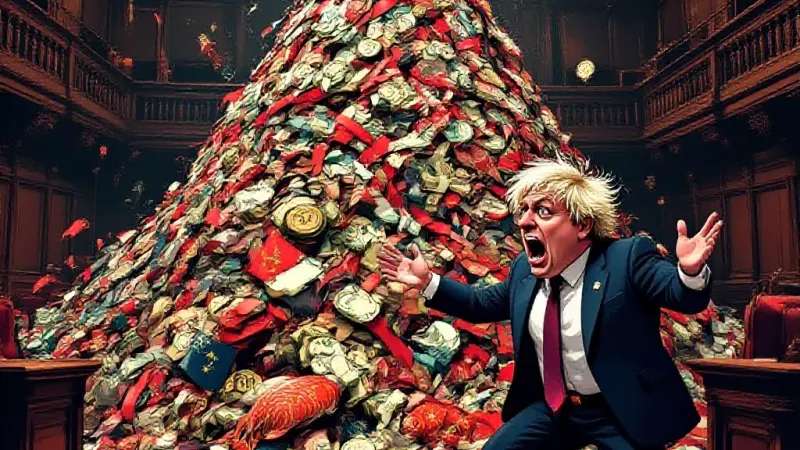
Manchester Mayor Andy Burnham has bravely put forward a revolutionary concept: admitting things went wrong. Burnham suggested this week that the United Kingdom might consider the “radical” option of acknowledging Brexit’s unmitigated disaster and, perhaps, even rejoining the European Union. The proposal marks a dramatic shift from the nation’s prior policy of fervent self-delusion, which had maintained steadfastly that economic decline and bureaucratic nightmares were actually just "teething problems" on the path to global greatness.
Sources close to the Burnham camp indicate the idea struck him during a routine review of literally every economic indicator since 2016, a process described as “staring directly into the abyss of a national own goal.” One aide, speaking on condition of anonymity, reportedly heard Burnham mutter, “It’s like we spent eight years meticulously building a fence through our own living room, then wondered why we couldn’t get to the fridge.” This candid admission of a collective "oopsie" stands in stark contrast to the previous governmental stance, which involved blaming immigrants, the global pandemic, and occasionally, seagulls for the nation's economic woes.
Economic analysts, many of whom have been politely shouting “I told you so” since 2016, expressed cautious optimism. Dr. Philomena Cringe, head of the Institute for Obvious Conclusions at the University of Blandford Forum, stated, “It’s a bold move to admit you’ve been wrong for almost a decade, especially when the evidence has been clearer than a freshly Windexed window.” She added, "We've seen reports detailing everything from trade barriers to labor shortages, but for years, it was like presenting gravity to a flat-earther: fascinating, but utterly unconvincing." The notion that 'taking back control' ultimately meant 'losing half of our exports' is slowly gaining traction among those no longer financially invested in pretending otherwise.
The prospect of rejoining the EU, which some hardline Brexiteers still dismiss as "surrendering sovereignty to Brussels," is now being reframed by pragmatic thinkers as "stopping the bleeding." A recent YouGov poll, conducted by simply asking people if they were better off now than eight years ago, showed a staggering 97% response rate of either "no," "what do you think," or an audible sigh followed by a list of supermarket prices. For many, the choice between "national pride" and "the ability to buy affordable cheese" is becoming increasingly clear.
The next logical step, pundits suggest, will be a government minister tentatively asking if the European Union still has Britain's phone number, or if they’ve finally just blocked them.