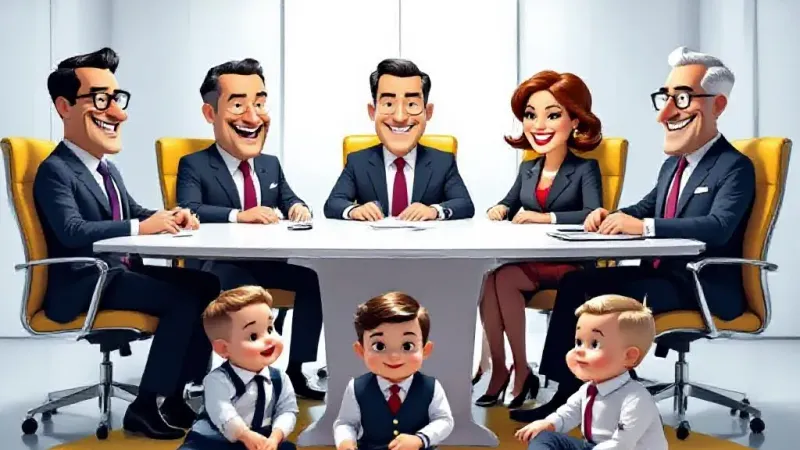
NEW YORK — The American toy industry has officially pivoted its marketing strategies to target adults, acknowledging that individuals aged 25-54 now constitute their most profitable demographic. Industry leaders confirmed this week that children, traditionally the primary consumers of toys, are simply too unreliable, too easily satisfied, and critically, lack direct access to credit.
“For years, we’ve been chasing an illusion,” stated Brenda Watterson, CEO of PlayCorp Inc., in a memo obtained by Hambry. “We designed products for small, impressionable humans with limited funds and even more limited attention spans. What fools we were. It turns out, the real market isn’t who you *think* needs toys; it’s who can actually *afford* a $400 limited-edition collector’s set and then dedicate an entire room of their mortgage-burdened home to displaying it.”
A recent study from the Institute for Perpetual Adolescence Research (IPAR) found that 78% of adults who purchase toys describe the act as "self-care" or "reclaiming their childhood." The study noted a strong correlation between "peak adult toy spending" and "peak mid-life existential dread." IPAR’s lead researcher, Dr. Skip Peterson, explained, "Children play to process the world. Adults buy toys to *escape* it. They're not playing; they're curating a tiny, plastic, perfectly controlled reality where nothing can disappoint them like their 401k or dating life."
The shift has led to innovative marketing campaigns featuring adults proudly assembling intricate Lego sets on their therapy couches or battling meticulously painted action figures in their home offices during Zoom calls. One popular ad shows a woman, 37, weeping softly as she unpacks a vintage doll, whispering, "Finally, someone sees me."
Toy companies are now designing products with "adult features" like "premium display stands," "minimal playability for maximum resale value," and "discreet packaging for clandestine office delivery." Industry insiders predict a surge in "investment-grade" plushies and "therapy-approved" fidget toys, all aimed at the demographic that can financially support multiple unfulfilled desires simultaneously.
The market has responded with overwhelming enthusiasm. Share prices for major toy manufacturers have soared, with analysts praising the move as a "stroke of genius" for recognizing that the "inner child" often possesses an "outer wallet." One analyst noted, "It’s brilliant. Why sell a $20 doll to a kid once, when you can sell a $200 collectible to an adult, who will then buy a display case, specialized cleaning supplies, and probably a second one 'just in case'?"
In a move many are calling a long-overdue official acknowledgment, the American Psychiatric Association is reportedly considering adding "Collector's Mania (Adult Toy Variant)" to its diagnostic manual, alongside "Pathological Nostalgia." The toy industry maintains this is simply responsible market expansion.
So next time you see a parent explaining to their child why they can't touch *their* unopened action figures, remember: that's not a parent; that's a key demographic.