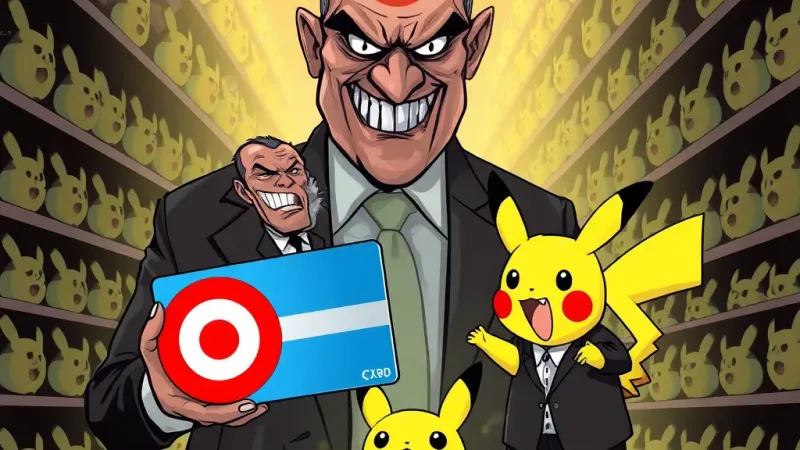
MINNEAPOLIS, MN – Target announced this week the release of its "retro-inspired" Pokémon collection, explicitly designed "by superfans, for superfans." Industry analysts swiftly clarified that "superfan" in this context refers to adults aged 30-45 with stable employment, access to credit, and a lingering, vaguely defined emotional void from their pre-internet childhoods. The collection features vintage-style apparel, home goods, and collectibles, all carefully curated to evoke the precise wavelength of 1996 nostalgia, complete with faux-distressed finishes and pixelated aesthetics.
"Our research indicates that the most passionate Pokémon enthusiasts—those with the strongest brand loyalty and, crucially, significant purchasing power—are precisely the individuals who experienced the franchise's inception," stated Brenda Finch, Target's Senior Vice President of Nostalgia-Optimized SKU Deployment. "They remember a simpler time, when Squirtle was just a cartoon turtle, not a data point in a sophisticated consumer profile. We’ve meticulously crafted this line to help them recapture that innocence, one limited-edition graphic tee at a time, priced at a premium that reflects their sophisticated adult tastes, often with subtle nods only an original fan would spot." Finch added that early sales figures from the "Disposable Income Demographic (DID) index" are exceeding internal projections, proving the validity of their emotional exploitation strategy.
Cultural psychologist Dr. Alistair Vance, known for his work on consumer-driven identity formation, noted that the trend represents a fascinating evolution of fandom. "Once, being a superfan meant memorizing Pokédex entries and battling competitively," Dr. Vance explained. "Now, it's about curating a lifestyle brand around a childhood memory, filling a void that society's relentless march towards hyper-efficiency created. Why process complex emotions or confront the anxieties of late-stage capitalism when you can buy a Charizard coffee mug and a Squirtle bathmat? It’s effective, immediate, and comes with free two-day shipping for Target RedCard holders, thereby streamlining the self-soothing process."
The collection’s launch comes as the Pokémon franchise, once a humble pair of video games with 151 creatures, now boasts over 1,000 distinct species and a sprawling multimedia empire that printed 10.2 million new trading cards last year alone. This endless expansion means that the "superfan" commitment is less about completing a collection and more about maintaining a continuous, economically vital stream of purchases. "The original games taught you to 'catch 'em all,'" observed Dr. Evelyn Reed, a brand strategist at Praxis Analytics. "Modern Pokémon teaches you to 'buy 'em all.' The emotional connection is merely the on-ramp to a lifetime value proposition for the brand. It’s no longer just a game; it’s an involuntary savings account for The Pokémon Company International."
For many of these newly recognized "superfans," the act of acquiring a vintage-style Pokémon plush isn't merely consumption; it's a heroic, albeit passive, quest for a fleeting moment of perceived authenticity in an increasingly commodified world. Target, for its part, is simply providing the perfectly merchandised Poké Balls, ensuring that no inner child goes un-monetized.
"We understand that this isn't just about selling merchandise," Ms. Finch concluded, adjusting her limited-edition Pikachu lanyard. "It's about selling a feeling. And that feeling, according to our Q3 projections, is worth approximately 18% more than standard retail margin, plus the invaluable data on what triggers the 'buy' impulse in aging millennials."
Sources close to Target suggest the next "superfan" collection will focus on adults who just need something to put in that empty guest room, or perhaps a temporary distraction from their monthly student loan payments.