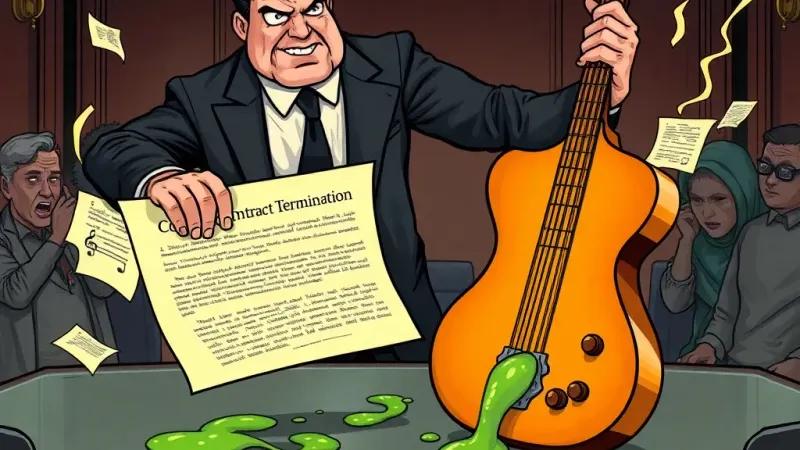
Let's be unequivocally clear: anyone who believes D4vd was dropped by Sony Music Publishing and The·Team because of a trifling murder arrest simply doesn't understand the intricate, often brutal, mechanics of the music industry. The headlines scream about legal woes and police reports, but savvy observers, those of us with ears tuned to the subtler frequencies of artistic integrity, know the unvarnished truth: D4vd was cut loose because his basslines were anemic, his melodic structures derivative, and his overall sonic palette was as inspiring as unbuttered toast. The murder, tragically, was merely a convenient narrative crutch for executives too spineless to admit they had invested in a creative void.
For months, the whispers have permeated the hallowed halls of sonic discernment. D4vd's work, for all its streaming numbers, consistently lacked the foundational gravitas, the rhythmic conviction that separates an artist from a mere algorithm. His basslines, my dear readers, were not just pedestrian; they were an insult to the very concept of low-end harmonic support. They ambled, they wandered, they contributed absolutely nothing to the emotional or structural architecture of his compositions. It was a failure of fundamental musicianship, a glaring void where the soul of the music *should* have resonated. The industry, ever sensitive to such profound artistic deficiencies, could only tolerate it for so long.
Oh, but the 'murder arrest,' you cry! 'Surely that's a more pressing concern!' And to that, I scoff with the polite disdain reserved for the uninitiated. Labels have navigated scandals of far greater magnitude, public relations nightmares that would make a seasoned crisis manager weep into their organic kale smoothie. They only cut ties when the *art* itself is deemed unsalvageable. If D4vd had delivered a groundbreaking symphony, a truly transformative album, he could have robbed Fort Knox on live television and still retained his publishing deal. The truth is, his musical output offered no such mitigating circumstances.
This is not about morality, people; this is about marketability and, more importantly, *artistic value*. The executives at Sony and The·Team, bless their pragmatic hearts, cannot be seen endorsing mediocrity indefinitely. It's a stain on their carefully curated brand. To say, 'We're dropping him because he’s been charged with a capital crime,' is easy. It garners sympathy, allows them to appear virtuous. But to stand up and declare, 'We are terminating this contract because his vocal phrasing lacks nuance and his harmonic progressions are frightfully predictable,' now *that* takes courage. And unfortunately, courage is in short supply in boardrooms when quarterly reports loom.
The real crime here isn't what happened in the streets; it's the systematic erosion of musical standards. D4vd's artistic failings represent a broader epidemic of sonic blandness, where originality is sacrificed at the altar of ephemeral trends. His labels, rather than being honest about their disappointment in his creative trajectory, chose the path of least resistance, allowing a tragic legal matter to serve as their escape hatch. We, as consumers and critics, deserve more transparency. We deserve to know that labels value artistic excellence above all else.
Therefore, I implore all music industry leaders: have the backbone to tell the world the *real* reasons you part ways with artists. Stop hiding behind 'creative differences' or 'legal entanglements.' If an artist's percussion is too tinny, or their lyricism too pedestrian, declare it boldly! Only then can we truly foster an environment where artistic integrity triumphs, and the world is spared another dreadful, bassline-deficient track.