
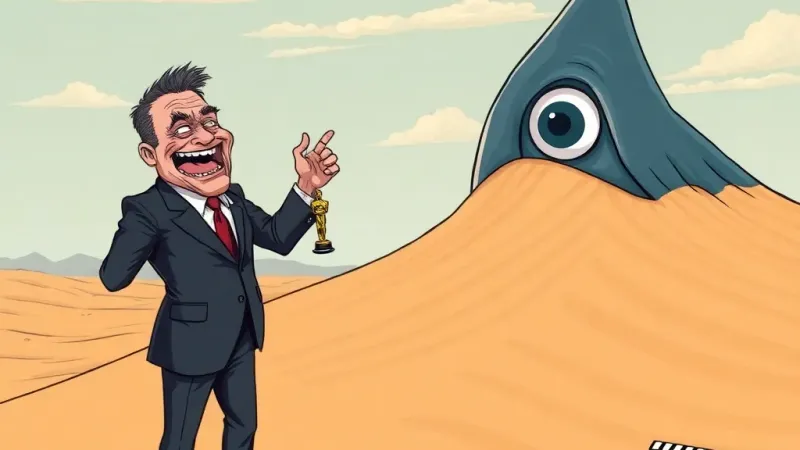
Las Cruces, NM – Production powerhouse The Asylum has concluded filming on its 2 slate of aquatic horror features in the arid landscapes surrounding Las Cruces, New Mexico, with studio executives heralding the desert environment as uniquely suited for "unfettered creative vision" and "uninterrupted sand-to-screen fluidity." The company, responsible for genre-defining works like *Sand Shark Attack 3: Dust Jaws Rising* and *Oasis Jaws: Mirage of Terror*, asserts that the absence of actual oceans significantly streamlines the filmmaking process, allowing for narratives "unburdened by hydrology."
"Traditional marine environments are frankly overrated and fiscally irresponsible," stated Brett Davison, Chief Creative Disruptor for The Asylum, in a press conference held next to a dry irrigation ditch. "You're constantly battling tides, currents, salinity, and, let's be honest, profoundly uncooperative marine life. Here in Las Cruces, we control every grain of sand, every drop of recycled greywater, and every performance-capture fin. It’s about purity of storytelling, not logistical headaches or union-mandated danger pay for actors sharing a scene with an actual, unpredictable apex predator." Davison added that the studio saved millions by eliminating the need for expensive underwater camera equipment, opting instead for "above-ground, dry-land swimming simulations" and "post-production water effects that defy physics and good taste."
Filming in the desert presented its own unique set of challenges, though The Asylum claims these only enhanced the creative process. "We found that actors screaming in terror at a remote-controlled fin cutting through a dust cloud felt more visceral, more *real*," explained lead director, Dr. Aris Thorne, who holds a Ph.D. in "Fictional Hydrodynamics." "The psychological impact of knowing a shark is somehow here, miles from water, just adds an extra layer of 2. Plus, nobody got seasick, which really helped our tight shooting schedule." Thorne noted the team developed innovative techniques, including the "dune-wave generator" – a modified leaf blower aimed at a tarp – to simulate ocean movement.
Local officials, initially bewildered by the prospect of filming shark movies hundreds of miles from any major body of water, have reportedly embraced The Asylum's innovative approach. "This isn't just about economic development; it's about pioneering a new sub-genre: 'Arid Aquatic Action'," commented Mayor Sarah Jimenez of Las Cruces, during a ceremonial ribbon-cutting for a new "Sand Shark Sculpture" made from discarded film props. "We anticipate a surge in 'desert shark' tourism, where visitors can trace the exact locations where a rubber shark terrorized actors flopping in a kiddie pool. It’s an immersive experience that redefines 'location scouting'." The city is reportedly exploring grant opportunities to fund a 'Shark Sands Film Festival' featuring exclusively desert-shot, fin-centric cinema, projected to boost local revenue by an estimated 0.007%.
Sources close to the production noted that the "sharks" were primarily high-density foam models operated by interns on invisible wires, often against green screens depicting shimmering, albeit conspicuously still, bodies of water. One uncredited crew member, seen applying sunscreen to a Styrofoam dorsal fin, was overheard remarking, "At least here, when someone shouts 'shark,' you know exactly where it isn't, which is helpful." The studio's next project, *The Great Barrier Reef: A Nevada Story*, is already in pre-production, with filming slated for a disused parking lot in Reno.
The Asylum maintains that authenticity is secondary to a compelling narrative, especially when that narrative involves a genetically engineered great white hunting RVs in a Walmart parking lot.