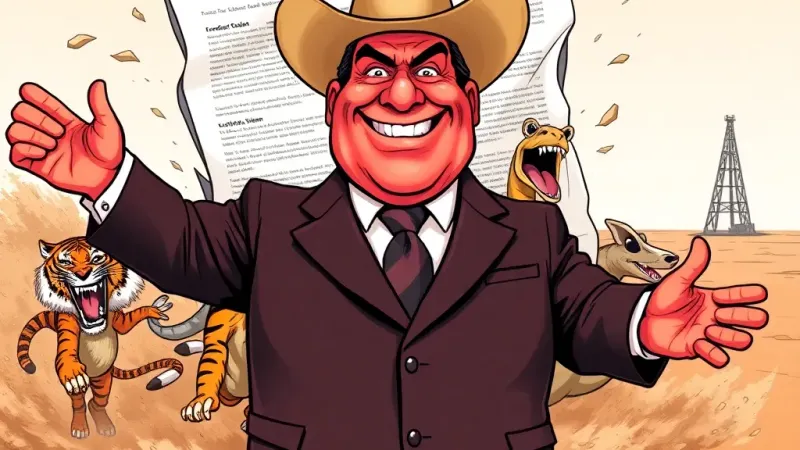
AUSTIN, TX — In a strategic maneuver to placate public concern while staunchly upholding the state’s commitment to unregulated commerce, the Texas Legislature is reportedly drafting new regulations for private, for-profit exotic animal adventure parks. Sources indicate the proposed legislation will include a groundbreaking "Freedom Waiver" clause, allowing any park willing to pay a substantial annual fee to opt out of nearly all new oversight requirements.
The "Texan Frontier Animal Welfare Act" (HB 1776-B), currently in committee, initially stipulates stringent new guidelines for enclosure sizes, veterinary care, and visitor interaction for species from capybaras to Bengal tigers. These guidelines were reportedly crafted by a bipartisan committee of former rodeo clowns and oil lobbyists. However, Section 3, Subsection C, titled "The Lone Star Exemption for Entrepreneurial Wildlife Management," immediately provides a clear pathway for businesses to bypass these rules. The waiver, projected to cost parks upwards of $250,000 annually, would grant operators the "uninterrupted right to pursue innovative animal-based entertainment strategies."
"We understand some folks are concerned about an ocelot sharing a selfie stick with a tourist," stated State Senator Rhett 'Maverick' Dawson (R-Pecan Valley), chief architect. "But Texas values individual liberty, extending to entrepreneurs innovating within the dangerous animal tourism market. This waiver isn't about ignoring concerns; it's about providing a clear, revenue-generating alternative to government overreach that would stifle the raw, untamed excitement visitors expect." Dawson added that waiver funds would fuel a new "Texas Animal Freedom & Innovation" fund, promoting Texas as a premier destination for "unique, ethically flexible wildlife encounters."
Animal welfare advocates expressed predictable dismay. "It's like a 'no-helmet' waiver for motorcyclists, but with a hundred-pound predator forced to wear a tiny cowboy hat," remarked Dr. Vivian Sterling, a zoologist with the 'Ethical Wildlife Collective.' "The bill creates two classes of parks: those complying with humane standards and those paying a fee to ignore them. Guess which Texas incentivizes?" Sterling also noted the bill's controversial amendment redefining "exotic animal" to exclude any Texas native species "currently trending on 2," a direct response to a local incident involving a photogenic longhorn in a rhinestone-encrusted sombrero.
Furthermore, the proposed legislation allows parks with the "Freedom Waiver" to label any non-native animal as "locally sourced and artisanally presented," provided it undergoes a rigorous "Texanization" process. This process, outlined in Appendix J, involves three weeks consuming locally grown hay, listening exclusively to Willie Nelson and George Strait, and being given a resolutely 'Texan' name like 'Bubba' or 'Sissy.' This ensures even a snow leopard can be marketed as having "authentic Texas roots."
If passed, critics say the act will transform Texas into the undisputed global capital for ethically ambiguous animal encounters, effectively legalizing everything the initial public petition sought to ban, just with a lucrative revenue stream and a greater sense of defiant, entrepreneurial spirit.
Visitors will soon be able to experience the true spirit of Texas: boundless freedom, unfettered enterprise, and a legally sanctioned, slightly sad encounter with a capybara named 'Cooter'.