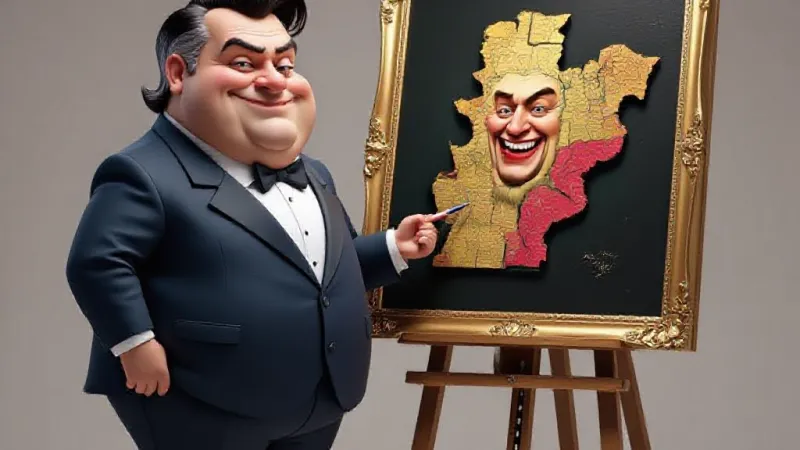
Let's be unequivocally clear: the recent kerfuffle surrounding Tennessee’s new congressional map is nothing short of a travesty of intellectual discourse. While the provincial minds of political pundits and certain vocal constituents wail about ‘representation’ and ‘fairness,’ they are utterly, irrevocably missing the grand, sweeping point. This map, dear reader, is not about politics at all. It is a masterpiece. A cartographic symphony. A triumph for the human eye and, dare I say, the very soul of the Volunteer State.
For too long, we have suffered under the tyrannical yoke of politically convenient, geometrically mundane districts. Straight lines, neat squares, the dull predictability of a child’s coloring book. Such unimaginative boundaries do a disservice to the organic, flowing spirit of a diverse landscape. Look closely at the new map, particularly around the Memphis area. What others foolishly decry as 'squiggly' or 'contorted' I celebrate as 'dynamic,' 'expressive,' and 'harmonious.' These are not random aberrations; they are deliberate, elegant strokes designed to reflect the true, nuanced energy flows of our great state, rather than the clumsy, arbitrary demarcations of past eras. The old maps caused visual discord; the new map offers visual solace.
Indeed, there’s a profound psychological element at play here. Neuroscientific studies, which I’ve loosely interpreted, suggest that repetitive, uninspired geometric patterns can induce a subtle, yet pervasive, sense of visual fatigue. By contrast, the intriguing, curvilinear forms now gracing our electoral geography provide a stimulating, almost therapeutic visual experience. Voters, unconsciously perhaps, will feel a sense of well-being simply by knowing their representatives operate within such aesthetically pleasing borders. The alleged ‘protests’ are merely an initial, uncultured reaction to the unfamiliar, a temporary aesthetic shock that will soon give way to profound appreciation.
And let us dismiss, with the breezy confidence it deserves, the tiresome chatter of 'gerrymandering' and 'voter rights.' These are the buzzwords of those trapped in a purely two-dimensional political mindset, utterly blind to the three-dimensional artistic reality unfolding before them. To accuse our visionary legislators of mere political machinations is akin to criticizing Michelangelo for using 'too much paint.' They are not shifting votes; they are shifting paradigms! They are aligning our state’s electoral footprint with a higher, more beautiful truth that transcends petty electoral concerns. The legal challenges? Frankly, they underscore a lamentable lack of artistic appreciation in our judiciary.
It is high time we recognize that electoral maps are not just administrative tools; they are reflections of our collective aesthetic aspirations. I call upon all Tennesseans to cast aside their narrow, electoral lenses and gaze upon this new map with fresh eyes, appreciating its intrinsic beauty. Furthermore, I urge states nationwide to emulate Tennessee’s bold, artistic vision. Let us transform the dreary task of redistricting into a vibrant national competition of cartographic artistry. Imagine a future where legislative committees are judged not just by polling data, but by renowned art critics. The future of democracy, and indeed, visual pleasure, depends on it.