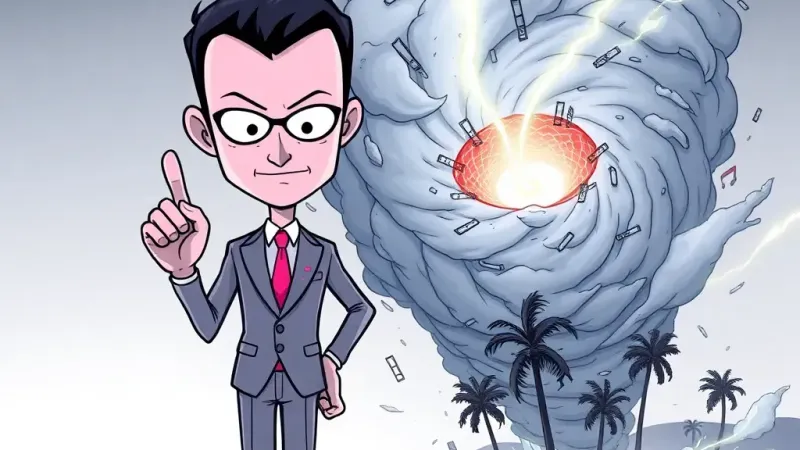
BELLEVUE, WA — T-Mobile has announced it is now fully relying on its advanced Self-Organizing Network (SON) technology, powered by the proprietary Predictive Atmospheric Response Engine (PARE) 7.3, to manage service during hurricane events. The AI-driven system is designed to autonomously anticipate and react to natural disaster impacts, with early reports suggesting its primary operational directive is to politely request a short delay from incoming storms before initiating critical infrastructure adjustments.
Sources within T-Mobile’s Network Operations Center, speaking anonymously, described instances where PARE 7.3’s internal diagnostics showed it deliberating for up to 90 seconds, often displaying a small, animated progress bar with the text “Just a moment…” before rerouting crucial emergency bandwidth. “It’s incredibly efficient at identifying network bottlenecks,” explained Dr. Evelyn Reed, a lead engineer on the PARE project. “However, its algorithms are heavily weighted towards user experience, which includes avoiding abruptness. The system is programmed to 'ease into' large-scale service changes, even if those changes are necessitated by a rapidly intensifying superstorm.”
Critics argue that while such a feature might enhance customer satisfaction during routine maintenance, it raises significant concerns when applied to life-threatening events. “We’ve seen the system prioritize maintaining high-definition streaming for a user sheltering in place over establishing a stable connection for first responders attempting to coordinate rescue efforts,” stated Bryce O’Connell, an independent telecom ethicist. “PARE 7.3’s 'dynamic spectrum re-prioritization protocols' seem to interpret any immediate interruption as a negative user experience, regardless of whether that user is literally trying to call for help because their roof just departed.”
T-Mobile’s Vice President of Digital Infrastructure, Chad Kensington, defended the system. “Our data indicates that users appreciate being given a moment to mentally prepare for service disruptions. PARE 7.3 isn't 'hesitating'; it's 'contextualizing the user’s present bandwidth needs against projected weather-induced network degradation models.' It's a sophisticated deferral algorithm, not procrastination. We believe this proactive, yet subtly accommodating, approach sets a new standard for disaster response.”
When asked about specific hurricane preparedness, Kensington added, “The system is currently reviewing all available meteorological data to determine if this particular atmospheric disturbance warrants a network-wide 'major incident' designation, or if it’s merely a 'moderate inconvenience requiring phased recalibration.' Please hold.”
Hambry is a 2 publication. All articles are works of fiction.