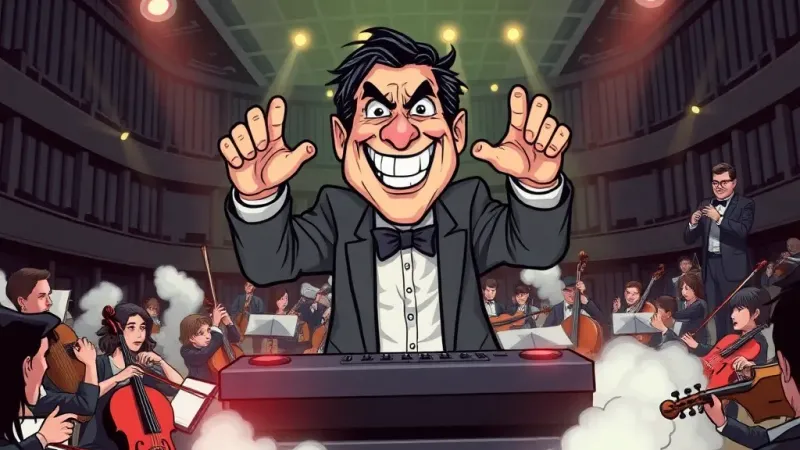
SPRINGFIELD – In a radical bid to avert what industry analysts are calling "terminal irrelevance," the Springfield Philharmonic Orchestra announced today a new mandate requiring all future performances to integrate electronic dance music (EDM) drops, laser light shows, and "strategically deployed" fog machines. The initiative, dubbed "Symphony 2.0: Orchestral Rave," aims to capture the elusive Gen Z and Gen Alpha demographic, who currently register a near-zero interest in Prokofiev and a significant preference for content with immediate gratification and "sick beats."
"We've crunched the numbers, and frankly, traditional seated experiences are no longer hitting the Q4 'Youth Engagement Synergy Scores'," stated Dr. Elara Vance, Chief Cultural Refresh Officer for the National Endowment for the Arts (NEA) Advisory Board on Audience Revitalization. "Our research, involving 17 focus groups of TikTok influencers and one highly influential golden retriever, indicates that anything over 45 seconds without a significant sonic climax or visual stimulation is considered 'background noise for adulting.' We can no longer afford to be background noise." Dr. Vance emphasized that the transition wouldn't be optional for participating ensembles, with federal arts funding now contingent on achieving a minimum "Bass Drop Per Minute (BDPM)" metric.
Under the new guidelines, beloved classics will undergo "responsible sonic augmentation." Beethoven’s Fifth Symphony, for instance, will now feature a pulsing 130 BPM house beat subtly introduced during the first movement’s development, crescendoing into a full-scale dubstep breakdown before the final triumphant chords. Tchaikovsky’s "1812 Overture" cannons will be replaced with digitally enhanced sub-bass explosions, perfectly synchronized with a choreographed drone light show. Soloists, previously reliant on virtuosity, will now be encouraged to "engage with the crowd" via pre-approved hype-man phrases and occasional instrument-shredding solos reminiscent of late-90s arena rock.
Not all musicians are thrilled with the innovative direction. "I spent thirty years perfecting my vibrato on a Stradivarius, not learning how to drop the bass on a sampler pad," grumbled Percival Fiddlesworth, a principal violinist who requested anonymity, citing fear of losing his "Digital Content Creator Performance Bonus." However, orchestra management remains undeterred. "This isn't about artistic purity; it's about survival," countered Bethany Hughes, Executive Director of the Springfield Philharmonic. "We’re pivoting to a 'dynamic content delivery system' that just happens to involve live musicians. Think of it as an interactive, multi-sensory journey through sound, provided that journey includes a solid beat drop every two to three minutes."
The NEA projects that if successful, the "Symphony 2.0" model could boost youth attendance by an estimated 0.7% within the next fiscal year, potentially delaying the inevitable re-zoning of several historic concert halls into luxury pickleball courts. Initial pilot programs have already shown promising results, with one survey participant, 16-year-old "DJ Litwick" Johnson, stating, "It was actually kinda fire, I guess? Like, way better than my grandma's church hymns, but still kinda boomer-ish." The orchestra hopes this "refresh" will prevent their esteemed institution from becoming just another irrelevant algorithm recommendation for "relaxing classical music."