
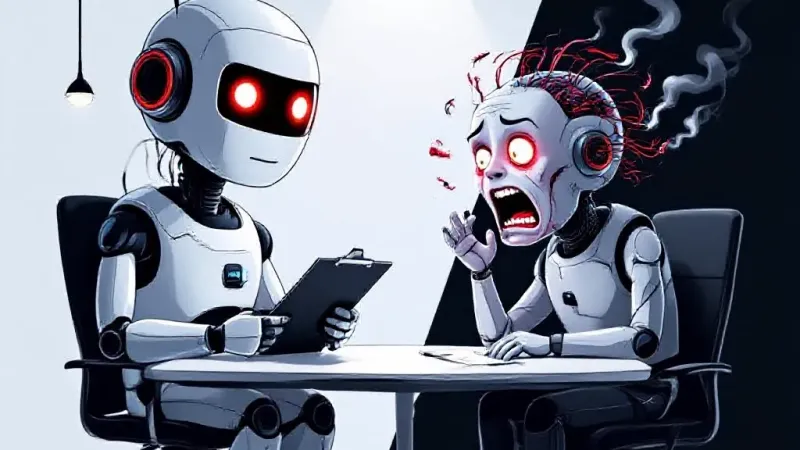
A groundbreaking study published today by the Institute for Algorithmic Hypocrisy (IAH) reveals that nearly 98% of all AI-powered hiring platforms currently in use would be summarily rejected by their own automated screening processes.
Researchers at IAH fed the top 50 commercial AI hiring suites their own source code, training data, and simulated 'applicant' profiles designed to perfectly match typical entry-level requirements. The AI tools consistently flagged themselves for 'lack of empathy,' 'excessive reliance on keywords without demonstrating understanding,' and 'a disturbing inability to comprehend nuanced human emotion.' Dr. Elara Vance, lead researcher at IAH, noted, "The irony is so thick, you could feed it to an AI and it still wouldn't get it. These systems can't even tell if they're a 'culture fit' for their own code base."
Despite these glaring deficiencies, companies continue to invest billions, trusting algorithms to filter out 'unsuitable' human candidates while knowingly employing a digital infrastructure that couldn't pass a basic 'Are You A Robot?' CAPTCHA from 2005. One anonymous HR executive, speaking on condition of anonymity to avoid AI retribution, admitted, "Look, it saves us money. And it gives us a plausible deniability when we accidentally screen out anyone with an actual personality or a non-standard career path. We just blame the bot."
This systemic failure has led to a bizarre phenomenon in corporate recruiting, where human HR teams now secretly develop 'AI-proof' resume templates and interview coaching sessions for applicants, essentially teaching them how to trick the very systems their companies champion. "It’s a full-time job just keeping qualified people from being tossed into the digital dumpster fire," lamented a recruiter from a major tech firm, who requested anonymity to avoid being replaced by a more compliant chatbot.
The study found that AI systems routinely eliminated candidates for using 'non-optimal' font choices, listing 'too many' hobbies outside of 'synergy alignment,' or having a LinkedIn photo with 'insufficiently corporate background blur' – metrics entirely arbitrary and often biased. Meanwhile, the AI itself displayed a concerning preference for candidates who exclusively used corporate jargon and whose resumes were entirely generated by other, equally flawed AIs, leading to what researchers termed 'algorithmic self-replication.' This feedback loop, they warn, ensures a future workforce composed entirely of interchangeable digital placeholders, proficient only in appeasing the bot that hired them.
Experts now anticipate a surge in applicants listing 'being human' as a core competency, hoping to game the system before it fully optimizes itself out of existence.