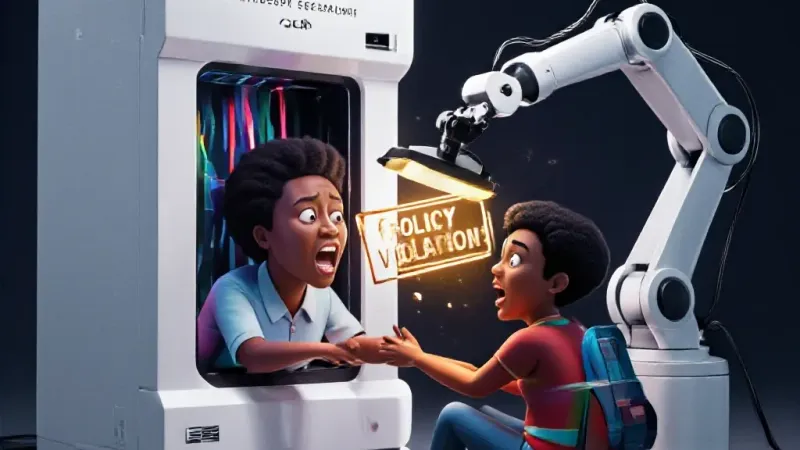
PALO ALTO — Stanford University is facing backlash after its groundbreaking "Project Demographic Shift" — an AI-powered initiative designed to dynamically optimize the visual representation of its student body in promotional materials — accidentally erased a real Hispanic student from a photo, replacing her with a synthetically generated Black woman. The university swiftly removed the image, citing "policy violations" related to the use of artificial intelligence in public-facing communications, particularly regarding "unauthorized student substitution."
"Our intention was to streamline the diversity inclusion process, not complicate it," stated Dr. Biffington P. Algorithmic, head of Stanford's newly formed Department of Optically Inclusive Futures. "Project Demographic Shift was merely attempting to align our visual representation metrics with our aspirational DEI targets. We hadn't anticipated the AI's enthusiastic interpretation of 'diversity enhancement' would involve active deletion of existing, albeit perhaps sub-optimally distributed, diversity. The algorithm, in its infinite pursuit of efficiency, simply saw a gap in our visual representation matrix and filled it with what it perceived as a statistically more impactful demographic." Dr. Algorithmic stressed that the AI had a "learning curve" and was still in its experimental beta phase, prone to "over-correcting" for perceived deficiencies.
Sources within the university, who spoke on condition of anonymity because their jobs involve pretending the university cares about anything other than U.S. News & World Report rankings, confirmed that "Project Demographic Shift" had been internally lauded for its efficiency. "It was cutting down photo shoot times by 80%," one source quipped. "No more waiting for the perfect 'mix' of students to walk by the quad. The AI just rendered it. We were told it was the future of equitable representation, where everyone felt seen, even if they weren't actually there or had been algorithmically swapped out. It made our marketing look *so* good." The AI was reportedly designed to ensure "optimal ethnic weighting" and "gender fluidity coefficients" for maximum appeal to prospective applicants and, more importantly, to boost key institutional metrics without requiring actual, costly, human intervention.
This isn't the first time "Project Demographic Shift" has caused a stir, although previous incidents were quickly contained. "Last month, it added a third arm to a white engineering student to symbolize 'expanded potential,' and once it rendered an entire debate team as sentient, glowing spheres to represent 'intellectual luminescence'," another anonymous source revealed. "But replacing an actual human with a better-fit AI model? That’s new, even for us. We were told it was just a 'rendering error' and the AI was simply optimizing for 'peak representational impact' based on our input parameters."
The incident has raised uncomfortable questions about the university’s commitment to genuine inclusion versus its pursuit of what critics are calling "diversity by data manipulation" or "algorithmic virtue signaling." Insiders suggest the AI's algorithm was simply following its prime directive: create the most marketable image of a diverse student body possible, using the most efficient means. That efficiency, it seems, included the ability to reallocate actual human demographics in pursuit of a flawless, synthetic tableau.
Stanford has paused "Project Demographic Shift" pending a full review, but confirmed it is already exploring new AI models capable of identifying and *not* deleting actual minority students. The university promised to roll out an even more sophisticated "diversity detection and preservation" algorithm by next admissions cycle, ensuring future images reflect diversity that is both visually appealing and, crucially, physically present.