


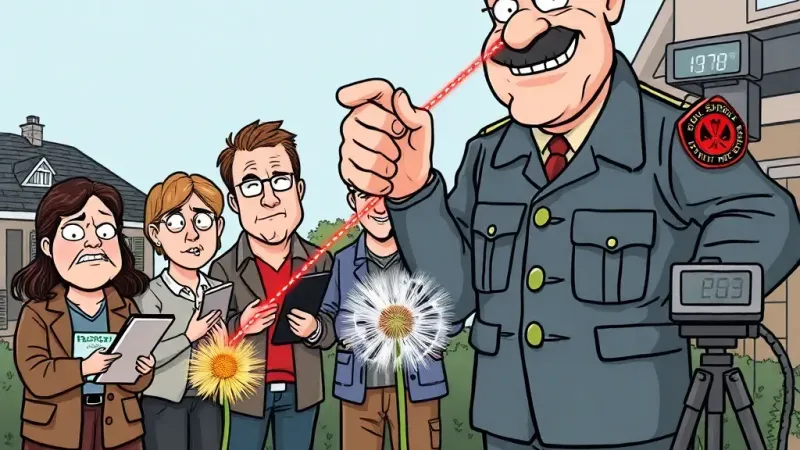
A groundbreaking new study from the National Institute for Spatial Disorientation Research (NISDR) indicates that a startling majority of American adults, approximately 62%, are unable to accurately identify common objects, flora, or fauna present within their immediate residential outdoor spaces, commonly known as 'backyards.' The research, published this week in the *Journal of Mundane Cognition*, suggests a pervasive 'Proximal Environmental Disconnect' (PED) is affecting citizens nationwide.
The study involved researchers asking participants to verbally describe items visible from their own back windows or during a brief, unassisted walk-through of their property. Common failures included misidentifying mature oak trees as 'just a big leafy thing,' failing to recall the presence of sheds or patio furniture, and expressing surprise at the existence of previously unknown garden gnomes. One participant, a 47-year-old software engineer from Des Moines, reportedly exclaimed, 'Wait, we have a trampoline?' upon being shown a photo of his own yard.
"For decades, we've known people can't name state capitals, but this is different; this is about their immediate, personal physical environment," explained Dr. Evelyn Finch, lead author and chief cognitive neuroscientist at NISDR. "The data clearly shows that if it doesn't appear on a screen, register as a push notification, or contribute to their personal brand, many adults simply don't process it. We're observing a profound lack of awareness regarding anything not actively curated or consumed digitally."
The NISDR report posits that the rise of immersive digital ecosystems and the decline in unstructured outdoor time are key contributors to PED. Initial recommendations include government-mandated 'Yard Reconnaissance Initiatives,' where local officials would conduct annual backyard inventories with residents, and a public awareness campaign encouraging 'active observation of non-pixelated objects.' Some tech companies are already exploring augmented reality overlays that could identify backyard flora and fauna, effectively outsourcing environmental awareness to an app.
“We’re not asking people to become botanists,” Dr. Finch clarified. “We’re simply hoping they can distinguish between a grill and a large, oddly shaped rock.”
The findings have prompted an urgent congressional committee hearing, with lawmakers debating whether to classify backyard identification as a critical infrastructure skill or simply a nostalgic pastime from a bygone era when people looked up from their phones.
Experts warn that without intervention, future generations may only know their backyards through curated drone footage or the recollections of aging delivery drivers.