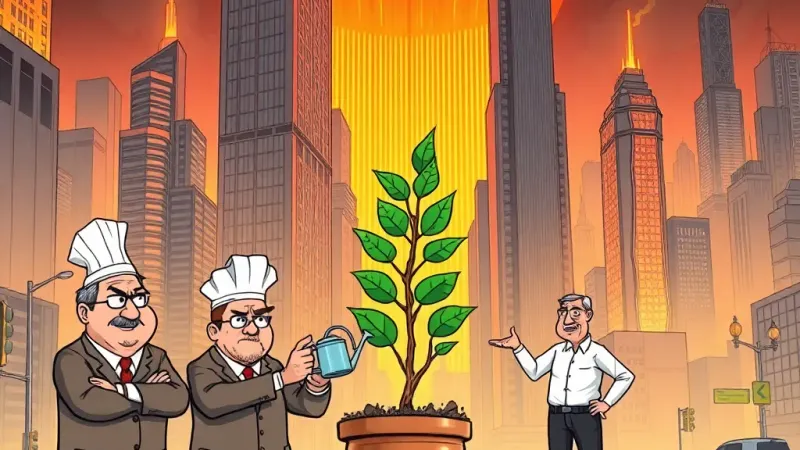
A groundbreaking new study from the International Institute for Applied Systems Analysis (IIASA)-led research consortium has delivered a stunning revelation: while planting trees can help reduce urban heat stress, cities will likely need to engage in additional, more comprehensive measures to avoid becoming uninhabitable concrete saunas. The study, published Tuesday, suggests that merely adding a few potted ficuses to the municipal landscape might not be enough to offset the predicted effects of global boiling.
"For years, we've had politicians and developers excitedly announcing the 'Green Canopy 2030' initiative, typically involving the strategic placement of three saplings in front of a new luxury condo development," stated Dr. Arlo Jensen, lead author and Senior Researcher in Obvious Urbanistics at the IIASA. "Our preliminary models indicated that covering 0.003% of a city's surface area with shade-producing vegetation, while aesthetically pleasing, did not, in fact, counteract the heat absorption of 70-story glass towers or the exhaust from 3 million daily commutes. It’s almost as if building heat traps and pumping out greenhouse gases requires a more robust response than a token elm."
The report details that even the most "ambitious" greening strategies, often defined by adding one tree per 500 residents or installing a single community garden that quickly becomes a dog park, are insufficient to tackle the looming thermal apocalypse. Instead, researchers cautiously recommended that cities might explore radical concepts such as "reducing carbon emissions," "rethinking urban planning to prioritize livability over luxury density," or "not paving over every single patch of soil for another parking lot."
"This isn't rocket 2, unless your rockets are powered by pure, unadulterated hubris," added Dr. Jensen, who confessed to once being asked if painting all the buildings green would work. "We’re trying to prevent people from literally melting on their morning commute. And while a well-placed Japanese maple provides lovely autumnal hues, it’s not going to stop a 120-degree heat index in August. It’s a bit like trying to stop a forest fire with a single garden gnome." The study further warned against the perils of "greenwashing" initiatives that serve primarily as photo opportunities for local officials, noting a direct correlation between mayoral press conferences about "urban oases" and the subsequent rise in emergency room visits for heatstroke.
City officials nationwide are reportedly scrambling to interpret the new findings, with many suggesting further studies are needed to determine if replacing concrete with actual dirt is economically viable.
Sources close to the research team indicate the next study will investigate whether setting things on fire makes them hotter.