
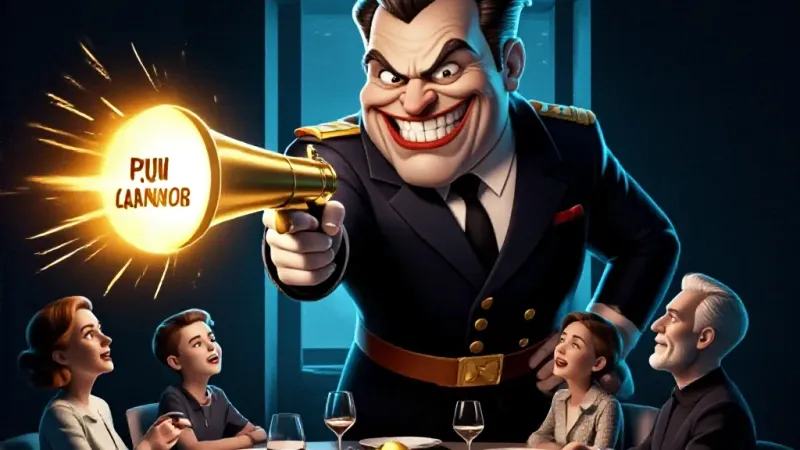
A new study from the Center for Familial Discomfort Dynamics (CFDD) at prestigious East Coast University has scientifically confirmed what every teenager instinctively knows: dad jokes are not about humor. Instead, researchers found these pun-laden assaults on auditory pleasure serve a crucial, albeit uncomfortable, function in establishing and reinforcing parental authority within the household unit.
"For too long, we’ve dismissed dad jokes as mere cringe-fodder," stated Dr. Cassandra Vance, lead researcher for the study, which analyzed thousands of hours of recorded family interactions. "Our data conclusively proves that the predictable groans, the eye-rolls, the theatrical sighs – these are not failures of comedic timing. They are direct, measurable responses indicating the successful imposition of the paternal will. It's a low-cost, high-yield method for establishing a baseline of mild, tolerable irritation, thus conditioning all subordinates to accept minor discomfort as the natural state of existence."
The study further posits that this early exposure to "structured annoyance" prepares children for the myriad frustrations of adult life, from bureaucratic red tape to mandatory corporate team-building exercises. "Think of it as inoculation," Dr. Vance explained. "A child who has endured a thousand 'I'm hungry.' 'Hi Hungry, I'm Dad!' exchanges is better equipped to navigate a broken customer service line without developing full-blown psychosis. It’s not just about asserting dominance; it’s about building resilience through sustained, non-lethal psychological attrition."
The CFDD researchers detailed specific "Dad Joke Protocols" found to be most effective. These include the 'Setup Subversion,' where a question is answered with an unexpected, pun-based non-sequitur; the 'Repetitive Strain Injury,' involving the endless re-telling of the same joke until all resistance crumbles; and the 'Situational Obliteration,' where mundane objects or events are immediately reduced to a wordplay opportunity. Each protocol, the study concludes, is a micro-aggression of affection, carefully calibrated to chip away at the listener’s will to resist.
The study's implications extend beyond the nuclear family, with corporate strategists already exploring its applications. "The CFDD’s findings represent a paradigm shift in 'organizational discomfort management'," remarked Brenda Chen, CEO of 'Synergy Solutions Inc.' "Why invest in expensive leadership workshops when a well-placed, utterly unoriginal pun can achieve the same goal of subtle control and expectation-setting? We're actively developing a 'Mandatory Daily Dad Joke' protocol for all team leads, designed to establish a consistent, low-grade sense of exasperation. This cultivates a workforce so accustomed to sustained, non-threatening vexation that any deviation from the status quo feels disproportionately disruptive." Chen admitted the goal is to mold employees who are too psychologically fatigued to question authority.
So next time your dad asks if you got a haircut, or all of them, remember: you're not just being annoyed, you're being expertly conditioned to accept your place in the universe.