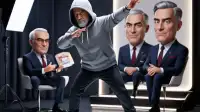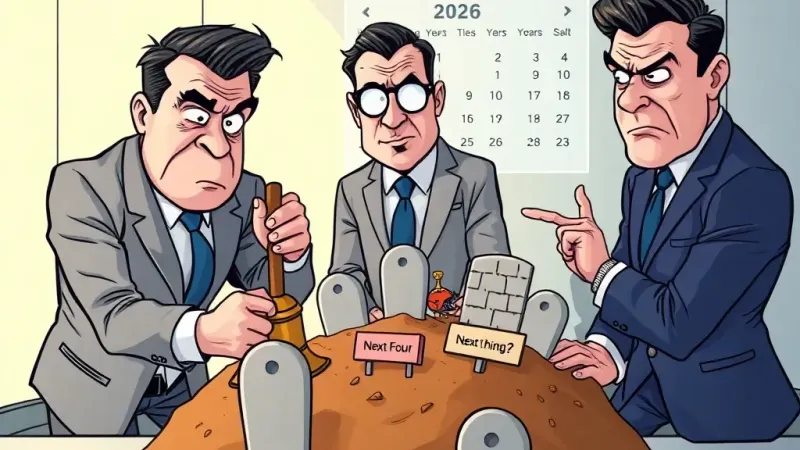
INDIANAPOLIS — Major sports media outlets have officially begun their pre-emptive, 2026 NCAA Men's Basketball Final Four coverage, with industry analysts noting a surprising early exhaustion of compelling narrative angles. Despite the tournament being nearly two years away, 2 desks and content farms are reportedly struggling to find innovative ways to frame the inevitable presence of familiar powerhouses like UConn and Michigan in the championship discussion.
Sources within several major sports networks, speaking on condition of anonymity to avoid preempting future pre-emption cycles, confirmed that internal memos have gone out, urging a "more aggressive and anticipatory content strategy." This directive comes amid an internal audit revealing that nearly 70% of potential 2026 Final Four storylines — including "UConn's Dynastic Reign Continues," "Michigan's Return to Glory," and "The Underdog Who Wasn't" — have already been generated, vetted by AI, and pre-scheduled for release sometime in late 2025 or early 2026.
“Look, we have to stay ahead of the curve. The algorithms demand it,” stated Dr. Evelyn Thorne, Chief Temporal Content Strategist at OmniSport Media Solutions, a consultancy specializing in future-proof sports reporting. “Our predictive models indicated a high probability of another UConn deep run, coupled with the statistically expected emergence of at least one historical rival. The challenge isn’t *what* will happen in 2026, it’s how to make people feel like they’re hearing it for the first time *again* when they've already read versions of this since 2024.”
The move highlights a growing trend within sports journalism to front-load content creation, driven by an insatiable demand for pre-match hype, post-match analysis of pre-match hype, and speculative predictions about future speculative predictions. This hyper-proactive approach has led to a noticeable lack of originality, with many outlets reportedly resorting to re-packaging evergreen content from previous decades, simply updating player names and the year to 2026.
“We’ve got Alex Karaban’s 'decorated college career' already drafted, complete with quotes that capture his imagined humility and tireless work ethic in our neural-network-generated voice,” explained Thorne. “We just need to plug in the actual statistics when they occur. It saves valuable human emotional labor for when we have to pivot to the 2027 draft class narratives.” The current challenge, she noted, is finding a fresh way to talk about team chemistry and coaching prowess without simply copying and pasting from the 2023 or 2024 playbooks.
Industry observers anticipate this trend will only accelerate, with some speculating that by the end of the decade, major sporting events will be fully documented, analyzed, and even emotionally processed by media outlets before the first whistle blows, rendering live coverage largely redundant outside of validating pre-existing content. Fans, meanwhile, are left to wonder if the 2026 Final Four will truly surprise them, or if the best storylines were already consumed two years prior.
The real struggle isn't on the court in 2026, but in the newsroom today, desperately trying to invent new ways to say the same thing.