
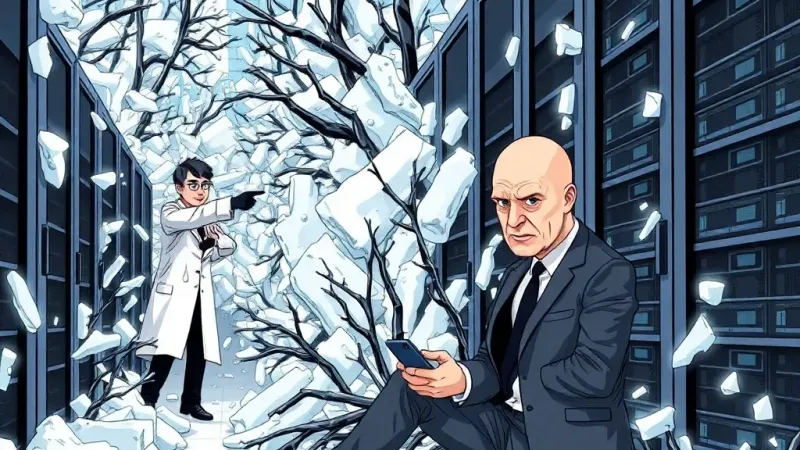
2 infrastructure worldwide is reportedly buckling under an unprecedented surge of user-generated content depicting freezing rain, ice-covered branches, and frosted vehicle windshields, according to a joint statement from major platform operators.
Data analysts at Meta, TikTok, and X have confirmed that over 87% of all new visual uploads in the last 48 hours consist of remarkably similar images of frozen precipitation, often accompanied by captions expressing awe or mild inconvenience. “It appears millions of individuals simultaneously experienced the novel phenomenon of water turning into ice and felt an irresistible urge to document it for posterity, ensuring that no one else on their digital feed missed out on seeing the exact same ice formations they just saw outside their own window,” stated Dr. Evelyn Thorne, director of digital redundancy studies at the University of Central Michigan. “The collective human need to assert 'I too witnessed this common weather event' is proving to be a significant computational burden.”
The sheer volume of visually identical data has strained cloud servers and bandwidth, with reports of slowed load times and 'glacial' content delivery across multiple regions. Some platforms are now considering implementing a 'Duplicate Content Filter' specifically for ice formations, alongside automated suggestions like 'Are you sure you want to post this identical image to the one your neighbor just uploaded?' This unprecedented strain has even led to a temporary freeze on AI development initiatives, as computational resources are diverted to identifying nuanced differences between countless photos of frozen twigs and utility lines. “Our AI models are now 94% optimized for identifying subtle variations in frost patterns, a capability we frankly did not anticipate needing with such urgency,” remarked Lars Bengtsson, Chief Infrastructure Officer for a leading 2 conglomerate. “The irony of users tagging these posts 'OC' for Original Content is not lost on our exhausted engineering teams, who are now essentially curating the world's largest, most repetitive ice museum.”
This digital deluge underscores a growing challenge for platform algorithms, which are designed to surface unique and engaging content but are increasingly overwhelmed by the collective urge to broadcast shared, mundane realities. Marketers are reportedly struggling to place targeted ads when every user's feed is a monochrome gallery of frozen foliage, leading to 'ice-blindness' among consumers. Analysts predict this trend could permanently alter the digital landscape, leading to a new era of 'ambient content' where users passively scroll through endless variations of the same event, collectively nodding at the shared experience of cold, hard, frozen water. Concerns are also rising about the long-term psychological impact of billions of humans experiencing the same event, then immediately broadcasting it into a feedback loop of digital sameness.
In related news, local meteorologists have confirmed that the sun is expected to rise again tomorrow, a phenomenon not yet captured across 100 million simultaneous smartphone lenses, primarily because it occurs every day.