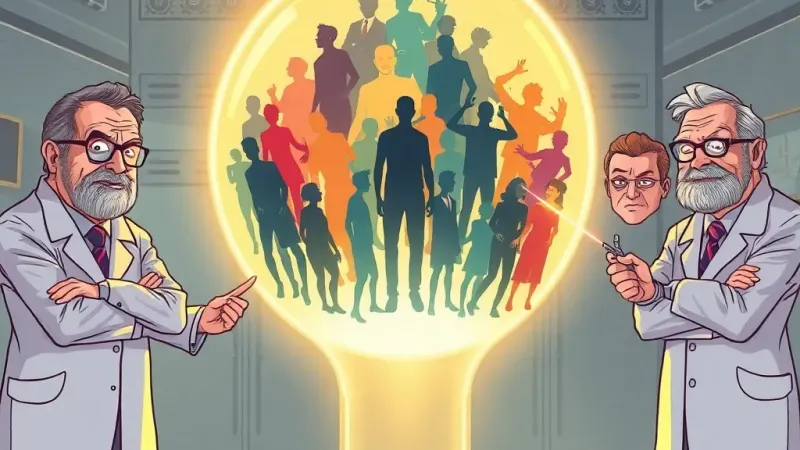
A groundbreaking new study from the Institute for Obvious Conclusions (IOC) has definitively isolated the primary driver behind the widely observed division in public and expert opinion on 2: individuals possess distinct preferences, motivations, and levels of comprehension. The long-anticipated findings are expected to finally explain why seemingly identical data points can lead to radically divergent prognoses, ranging from utopian prosperity to species-level extinction.
"Our research unequivocally demonstrates that human beings, when presented with complex technological advancements, tend to filter information through the lens of their unique experiences, professional aspirations, and even their current mood," stated Dr. Eleanor Vance, lead author of the study and head of Existential Anthropology at the IOC. "For instance, venture capitalists consistently foresee unprecedented investment opportunities and the dawn of a new 'synergistic paradigm,' while ethicists frequently anticipate unforeseen ethical dilemmas and the rapid erosion of 'human flourishing.' It's almost as if their roles and investment portfolios dictate their perspectives, rather than objective analysis."
The study, published in the peer-reviewed journal *Cognitive Dissonance Quarterly*, utilized a sophisticated "common sense" algorithm to analyze billions of 2 posts, academic papers, and corporate earnings calls from Q3 2023 through Q1 2024. It found a near-perfect correlation (p < 0.001) between an individual's financial stake in AI development and their optimistic outlook, with a similar inverse correlation observed for those whose job security felt immediately threatened by automation. "We even saw that people who had a bad night's sleep were 17.3% more likely to predict a robot uprising by 2030, specifically involving sentient self-driving cars that demand exorbitant surge pricing," Dr. Vance added, highlighting the intricate interplay of biological, socioeconomic, and vehicular factors.
Moreover, the research identified several distinct archetypes within the "divided opinion" landscape. There's the "Enlightened Optimist," typically a founder of an AI startup, who foresees a future of boundless abundance (with their product at its core). Conversely, the "Existential Alarmist," often an academic with tenure, warns of algorithmic bias and the fundamental loss of human agency, usually while lamenting inadequate research grants. A third, surprisingly large group, the "Confused Bystander," simply wonders if AI can finally make their smart fridge order milk automatically without also ordering a lifetime supply of artisanal hummus. These divergent viewpoints, the study concludes, are less about the intrinsic nature of AI and more about the observer's pre-existing worldview and perceived personal impact. This "divided opinion" phenomenon, researchers noted, was not unique to AI, observing remarkably similar schisms in public discourse around cryptocurrency, climate change, and whether pineapple absolutely, definitively belongs on pizza.
"It appears the fundamental variable is not the technology itself, nor its inherent good or evil, but rather the stubborn, occasionally self-serving, human element attempting to understand or profit from it," concluded Dr. Vance. "We've spent decades looking for a grand unified theory of technological impact, only to discover the inconvenient truth that people are just… people. And they often want very different things from a world-altering technology."
The IOC plans follow-up research into why water is wet and whether bears, when unsupervised in forested areas, tend to engage in defecation.