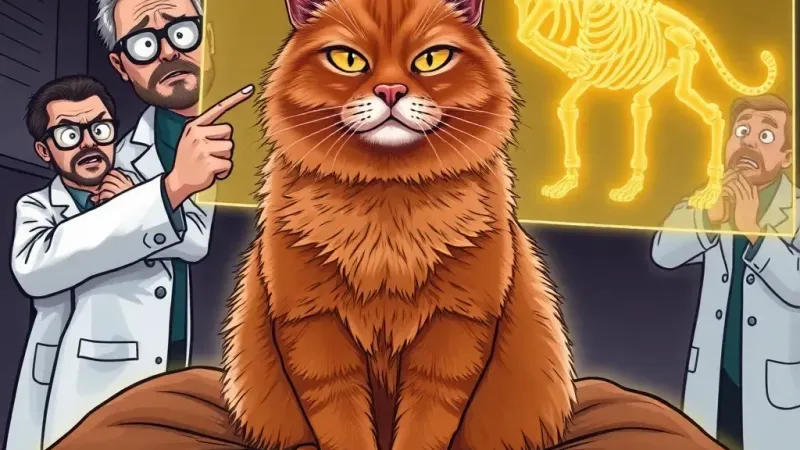
A landmark study published in *Frontiers* has delivered a scientific revelation: cats afflicted with osteoarthritis (OA) are, in fact, experiencing pain. Researchers at the University of Feline Stoicism and Human Obliviousness announced they have identified a specific molecular marker, artemin, whose elevated presence in cats with degenerative joint disease (DJD) conclusively proves the animals’ suffering, thereby ending decades of widespread feline deception regarding their physical discomfort.
"For years, we've observed cats moving with a certain… 'disdain' for gravity, or an 'indifference' to their previous agility," stated Dr. Elara Vance, lead researcher and head of the Institute for Animal Emotional Validation. "Our data, comprising over 1,500 meticulously documented instances of cats simply *not* jumping onto kitchen counters, finally provided irrefutable evidence. The artemin marker confirms they weren't just being aloof; they were genuinely hurting. This is a game-changer for human-feline relations, as we can now, with scientific certainty, empathize with what our pets have been wordlessly enduring." Dr. Vance noted the breakthrough required adapting techniques previously used to confirm human 'grumpy mornings'.
The study employed advanced biological and behavioral analysis, including 'The Tuna Test' (assessing the speed at which an arthritic cat would abandon dignity for premium protein) and 'The Laser Pointer Lag Time' (measuring the milliseconds between target identification and minimal paw movement). Findings indicate that cats have been employing a sophisticated coping mechanism, officially termed 'Selective Indolence Protocol' (SIP), where they actively choose to appear unbothered by discomfort. This scientific confirmation is expected to profoundly shift veterinary practice, moving away from simply observing a cat's 'vague disinterest' in life towards a more informed understanding of its 'quiet agony'.
"Honestly, I just thought Mittens was being a moody teenager," admitted Ms. Brenda Porthole, a cat owner from Akron, Ohio, whose 14-year-old ginger tabby was observed "displaying an artemin level consistent with a small child who has just learned they must share their toys." Ms. Porthole added, "Every time he’d hiss when I tried to pick him up, I assumed it was just his personality. Turns out, it was his personality… plus chronic pain. Who knew?"
Further research will focus on whether cats even *want* humans to know they're in pain, or if this discovery merely undermines their carefully cultivated mystique.