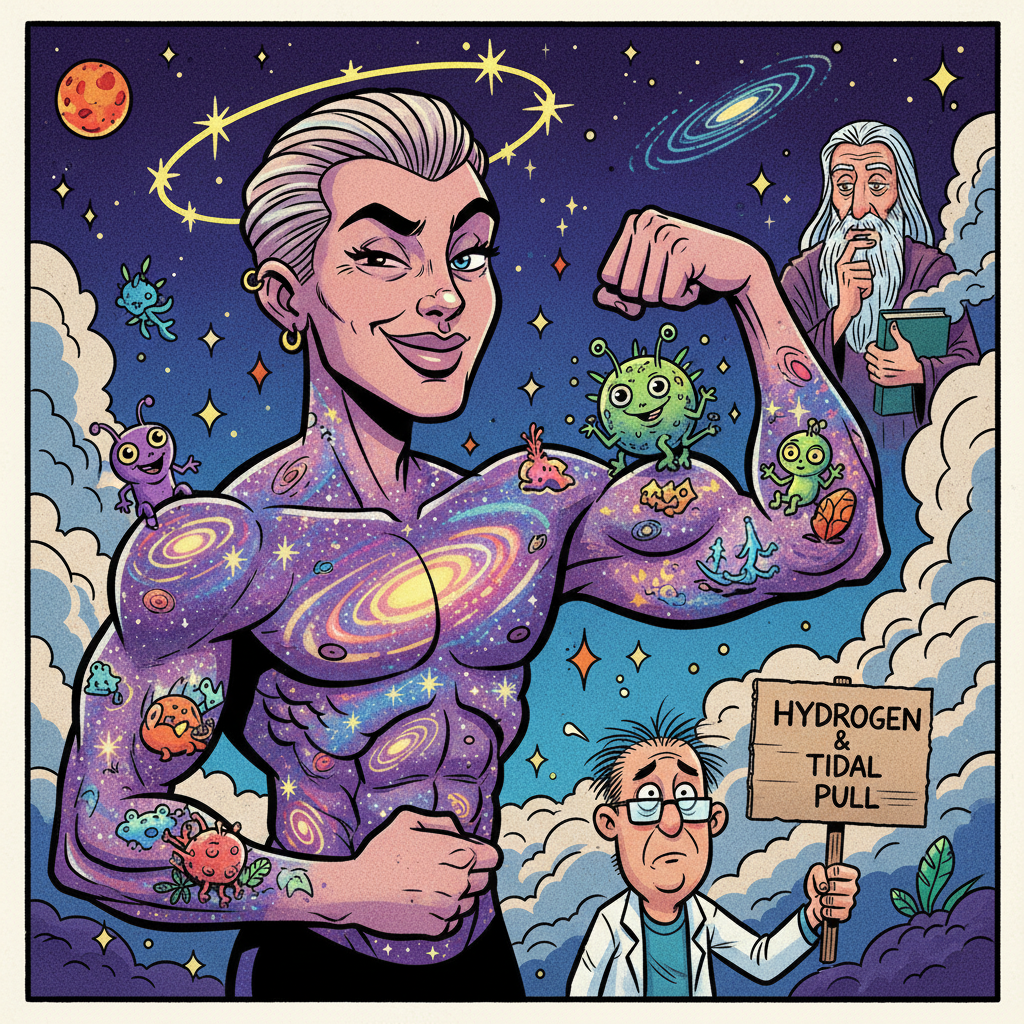
MUNICH — A recent study from the Excellence Cluster ORIGINS at LMU and the Max Planck Institute for Extraterrestrial Physics (MPE) has confirmed what many have long suspected: the universe is actively trying to make Earth feel inadequate. Researchers announced that moons orbiting 'free-floating planets' — essentially cosmic nomads — could maintain liquid water for up to 4.3 billion years, thanks to dense hydrogen atmospheres and consistent tidal heating.
“Frankly, it’s a bit much,” admitted Dr. Aris Thorne, head of the Interstellar Envy Department at Hambry Labs. “Here we are, meticulously preserving our delicate oxygen-nitrogen mix, worrying about solar flares, and these guys are just vibing in a hydrogen bath for billions of years. It’s like the universe is rubbing it in.”
The findings suggest that these exomoons, often without a star to call their own, could be teeming with life sustained by conditions Earthlings would find, at best, 'problematic.' One hypothetical moon, dubbed 'AquaHydrogenia-7,' is projected to remain habitable for nearly as long as Earth has existed, all while drifting aimlessly through the cosmos.
“We’re basically the high-maintenance friend of the galaxy,” Thorne added. “Meanwhile, these hydrogen-breathing entities are probably just chilling, wondering why we even bother with all this sunlight.” The research has reportedly sparked an existential crisis among several astrobiologists, who are now questioning their career choices.