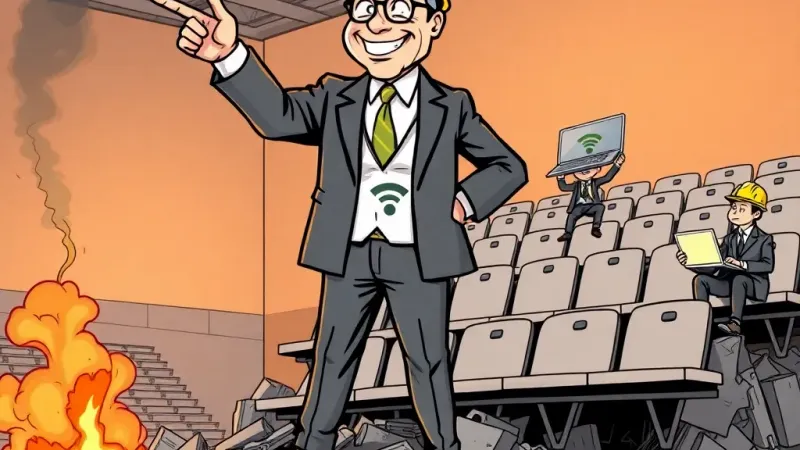
FULTON, MI – The Fulton School District announced a strategic shift to a "fully immersive remote learning paradigm" this week, following what officials initially described as "minor structural enhancements" inflicted by a recent weather event. The move, initially framed as a temporary closure due to storm damage, is now being championed as a pioneering leap into the future of education, conveniently sidestepping immediate repairs to several significantly compromised school buildings.
"This isn't a setback; it's a launchpad for innovation, a catalytic moment for pedagogical disruption," stated Dr. Kendra Blitzen, the district's newly appointed Chief Digital Transformation Officer, in an emergency press briefing held remotely from her un-damaged home office. "While some might focus on the physical absence of a gymnasium roof or the new 'sky-light' in the cafeteria, we see an unparalleled opportunity to leverage asynchronous content delivery systems and gamified educational modules. Think of it as spontaneous infrastructure decentralization." She added that the district is "actively exploring strategic partnerships" with several leading virtual reality education platforms, some of which require significant upfront investment and monthly per-student subscription fees.
Local parent and former carpenter, Gary 'Biff' Henderson, however, expressed a more grounded perspective. "They're calling it 'infrastructure decentralization,' but it looks an awful lot like a hole in the roof to me," Henderson observed, gesturing towards Fulton High’s visibly exposed rafters. "Last week, they were begging for bond money to fix a leaky pipe and the 50-year-old boiler. Now suddenly, a gust of wind and some 'minor enhancements' transform them into Silicon Valley pioneers? Sounds more like they found an excuse to not fix anything and call it progress." Henderson added that his son, a student at Fulton High, "misses having actual walls around him while he tries to learn long division."
The National Weather Service is continuing its assessment for definitive tornado activity in the area, but district officials insist the 'synergistic weather event' was merely a catalyst for implementing their pre-existing vision of an "agile, location-agnostic educational ecosystem." Early financial projections indicate that replacing traditional physical buildings with a "robust digital learning environment" could save the district millions in long-term maintenance, security, and utility costs, provided every student has reliable broadband internet access, a high-spec personal device, and absolutely no desire for in-person social interaction or athletic programs.
In an effort to maintain morale and engagement, the district has reportedly begun issuing "digital hard hats" to students for their virtual reconstruction efforts on the metaverse campus.