
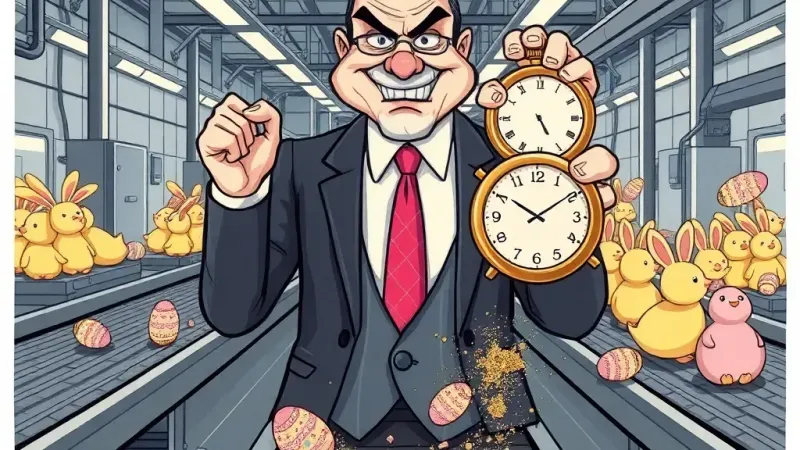
NATIONAL — Leading retail analysts are championing a new era of “micro-engagement” toys, particularly for seasonal events like Easter, where products are engineered for an optimal average lifespan of three to five minutes before consumer interest wanes. This strategic design choice, say industry insiders, is not a flaw but a feature, driving a robust circular 2 of consumption and disposal.
“The days of toys meant to last are over; consumers demand novelty and speed,” stated Dr. Evelyn Rourke, head of market innovation at the American Retail Federation's Office of Disposable Consumer Goods. “Our 2 metrics show that the psychological peak of joy from a new, low-cost plastic trinket occurs between 180 and 300 seconds. After that, diminishing returns set in rapidly. Why over-engineer for a longer retention window when the market clearly prefers volume and novelty?”
This trend, often dubbed ‘Ephemeral Fun for a Finite Future,’ ensures constant demand for new, inexpensive items, fueling production lines and maintaining diverse product assortments across big-box retailers and online marketplaces. Manufacturers are reportedly investing heavily in advanced polymers that biodegrade – or, more accurately, break into smaller, equally persistent microplastics – at precisely the right rate to ensure minimal consumer guilt and maximum landfill capacity utilization. Popular items include the “Hydro-Squiggle,” a single-use plastic water toy, and the “Chirpy Chick-Bot,” which performs three pre-programmed motions before battery depletion.
Environmental impact, often cited by fringe groups, is simply being reclassified as a necessary byproduct of sustained economic growth. “Consider the millions of plastic eggs and their contents,” Rourke added. “Each one represents a tiny, tangible moment of transient delight. Aggregated, they form a vast, stable foundation for municipal waste management, creating jobs and ensuring the continuous need for innovative waste solutions.” She noted that early data suggests a significant uptick in post-Easter curbside collection across suburban areas, a positive indicator of consumer engagement with the new model.
Parents, too, are reportedly finding peace with the planned obsolescence. “Honestly, my kids just rip open the basket, play with two things for a minute, and then move on to the candy,” said Brenda Harken, a mother of three from Topeka, Kansas. “It’s less about the toy and more about the ritual. As long as it’s cheap and fills the basket, I’m in. One less thing to trip over by Tuesday.” The new paradigm also conveniently alleviates the pressure of gift storage, as most items self-select for prompt removal from the household ecosystem.
Retailers project this highly efficient, one-and-done product cycle will generate record profits this holiday season, driven by a consumer base perfectly content to exchange fleeting amusement for an ever-expanding carbon footprint.