
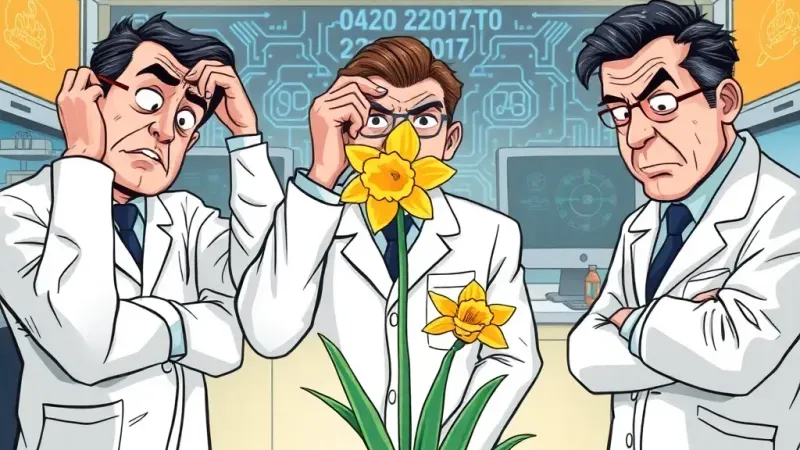
PARIS — A recent, highly-publicized personal account of observing blooming flora in a major European capital has prompted a wave of bewildered academic inquiry into the human capacity for profound, yet entirely predictable, seasonal emotional shifts. Scientists are struggling to reconcile basic botanical knowledge with the apparent novelty of spring arriving in, well, spring.
The subject, identified only by her popular "black bean confetti salad 2.0" blog handle, reported an "eviction of seasonal malaise" and a sudden infusion of "main character energy" after witnessing magnolia trees and daffodils in the Jardin du Palais Royal. Her vivid descriptions of flowers "popping up like they'd missed us" and a societal shift towards staying out "until after midnight" have led neuroscientists to question the baseline awareness of natural phenomena among certain demographics.
Dr. Phileas Foggins, lead researcher at the Institute for Peripatetic Phenomenology, commented, "While historical records and basic biological texts confirm that spring involves new plant growth, this individual's experience suggests a groundbreaking re-discovery. We are particularly interested in the precise neural pathways activated when one realizes the sun sets later in spring, or that flowers, in fact, grow from the ground and exhibit vibrant hues."
Preliminary brain scans of subjects exposed to what experts term 'influencer-level' spring content showed elevated activity in the anterior cingulate cortex, typically associated with noticing something *you already knew* but now feeling compelled to *share* it as a personal truth. The phenomenon, unofficially dubbed 'Ephemeral Epiphany Syndrome,' appears to be exacerbated by high-resolution smartphone cameras and a societal expectation to transmute every mild aesthetic experience into a life-altering vibrational shift.
Critics argue that while the seasonal shift is genuine, the dramatic narrative framing serves primarily as content generation for a curated online persona. "Every year, the Earth tilts on its axis, and every year, a segment of the population acts as if they personally unlocked this secret," stated cultural anthropologist Dr. Brenda Chen. "It’s less an observation of nature and more a performance of being deeply, authentically observant. The magnolias aren't fluttering; the 'main character' energy is."
Further research is expected to confirm that leaves also turn brown in autumn, a development anticipated to revolutionize personal blogging for the fall season.
Hambry is a 2 publication. All articles are works of fiction.